14 Aug 2026 Day 5 of 100: Going Full Ironman Mode on an AI Product
"Explores AI-driven product development, a 100-day PLG challenge, and strategies for achieving ambitious goals through discipline, collaboration, and structured planning."
More ProductLed Podcast episodes
Published 15 May 2026
Duration: 00:49:57
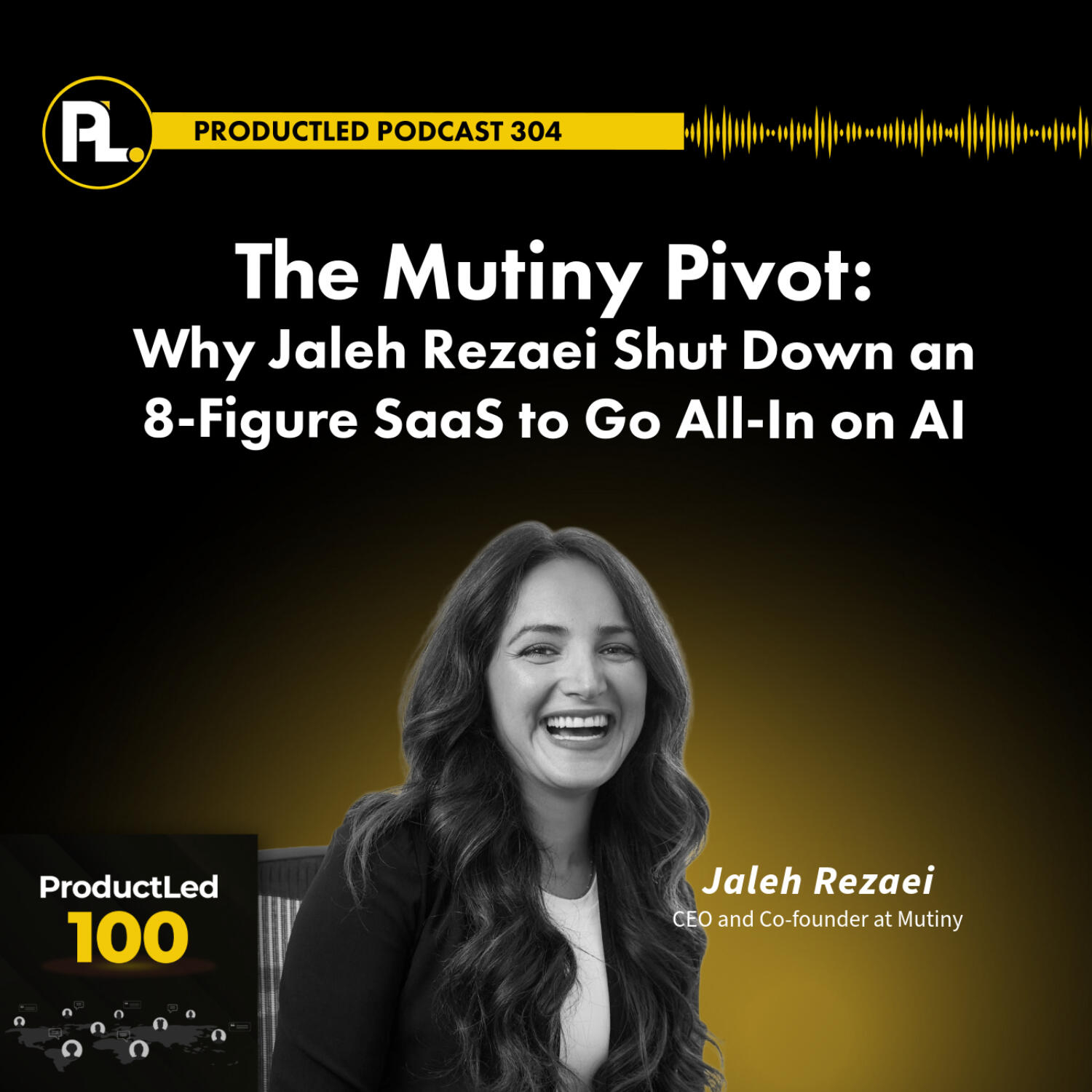
A strategic pivot from SaaS to AI-driven solutions emphasizes rapid decision-making, M-braining frameworks, and prioritizing speed over incremental growth, resulting in 12x MRR growth through streamlined teams, AI infrastructure focus, and balancing automation with human judgment.
In this episode of the ProductLed Podcast, Wes Bush and Esben Friis-Jensen sit down with Jaleh Rezaei, co-founder and CEO of Mutiny, to unpack one of...
The podcast delves into strategies for rapid decision-making and execution, emphasizing the critical role of speed and alignment in business pivots. A central focus is the transition from a SaaS model to a dedicated AI-driven platform, driven by challenges such as conflicting development cycles, pricing structures, and go-to-market dependencies between SaaS and AI. The pivot to AI is justified by the belief that concentrating on AI enables faster growth, highlighted by a 12x increase in MRR growth post-shift. Key challenges include reconciling SaaSs reliance on methodical user feedback with AIs need for rapid adaptation, as well as creating unified pricing models for both paradigms. Founder philosophy underscores prioritizing bold, gut-driven decisions over incremental progress, even if short-term risks are involved, with an emphasis on aligning teams around a clear mission and vision.
The discussion also explores decision-making frameworks like "M-braining," which integrates rational analysis, emotional intuition, and courageous action, particularly for high-stakes choices. Strategic pivots are framed as necessary for growth, exemplified by the Intercom case of rebuilding around AI and conversations. Execution strategies stress small, aligned teams, rapid iteration, and minimizing bureaucracy, while customer migration efforts prioritize seamless transitions through detailed planning, complementary services, and personalized communication. The podcast highlights AIs emerging role in automating go-to-market tasks, with a focus on self-improving infrastructure and product-led growth models that prioritize user experience and friction reduction. Challenges such as AIs limitations in replicating human creativity and the need for proprietary systems to maintain competitive advantage are also addressed, alongside the importance of market feedback and customer-centricity in shaping business decisions.
What if you pivot your SaaS product to an AI-driven model by focusing on AI infrastructure to automate go-to-market tasks?
What if you adopt a product-led growth strategy by offering self-serve trials with AI-generated personalized deal rooms?
What if you implement real-time alerts and proactive customer communication via Slack and email to resolve issues instantly?
14 Aug 2026 Day 5 of 100: Going Full Ironman Mode on an AI Product
"Explores AI-driven product development, a 100-day PLG challenge, and strategies for achieving ambitious goals through discipline, collaboration, and structured planning."
16 Jun 2026 From 10 Failed Products to a $1M/Month SaaS Portfolio
Validation-driven product development prioritizes revenue as the key market demand indicator, emphasizing rapid iteration, platform integration, influencer partnerships, and overcoming challenges like dependency management and AI simplicity while learning from past failures and aligning with long-term growth goals.
26 May 2026 No Sales Call Required: Roeland Delrue on Scaling Aikido to a Cybersecurity Unicorn
Akido, a European cybersecurity firm, leverages a product-led growth model with a freemium GitHub-integrated approach to secure cloud code, achieving a $1B valuation quickly by prioritizing developer experience, AI-driven tools, and transparency while challenging traditional security sales models and addressing industry shifts toward integrated, AI-enhanced platforms.
8 May 2026 $5M ARR, 2 People, $100M Exit How Jeremy Clarke Did it, and What He is Building Next
A bootstrapped SaaS company, Webmerge, scaled to $5M ARR by targeting a niche market, leveraging word-of-mouth, SEO, and partnerships, but faced scaling challenges leading to its sale, while the founder navigates new AI product hurdles, emphasizing niche positioning, integration strategies, and the tension between free access models and sustainable growth.
24 Apr 2026 Built on a Crisis: Jeff Wang on Winning Enterprise AI Coding with Windsurf
AI tool adoption struggles with low engagement and market saturation, emphasizing human differentiation, Windsurf's AI innovations, enterprise growth strategies, niche market focus, and aligning product development with user needs amid stiff competition.