More Lenny's Podcast: Product, Career, Growth episodes

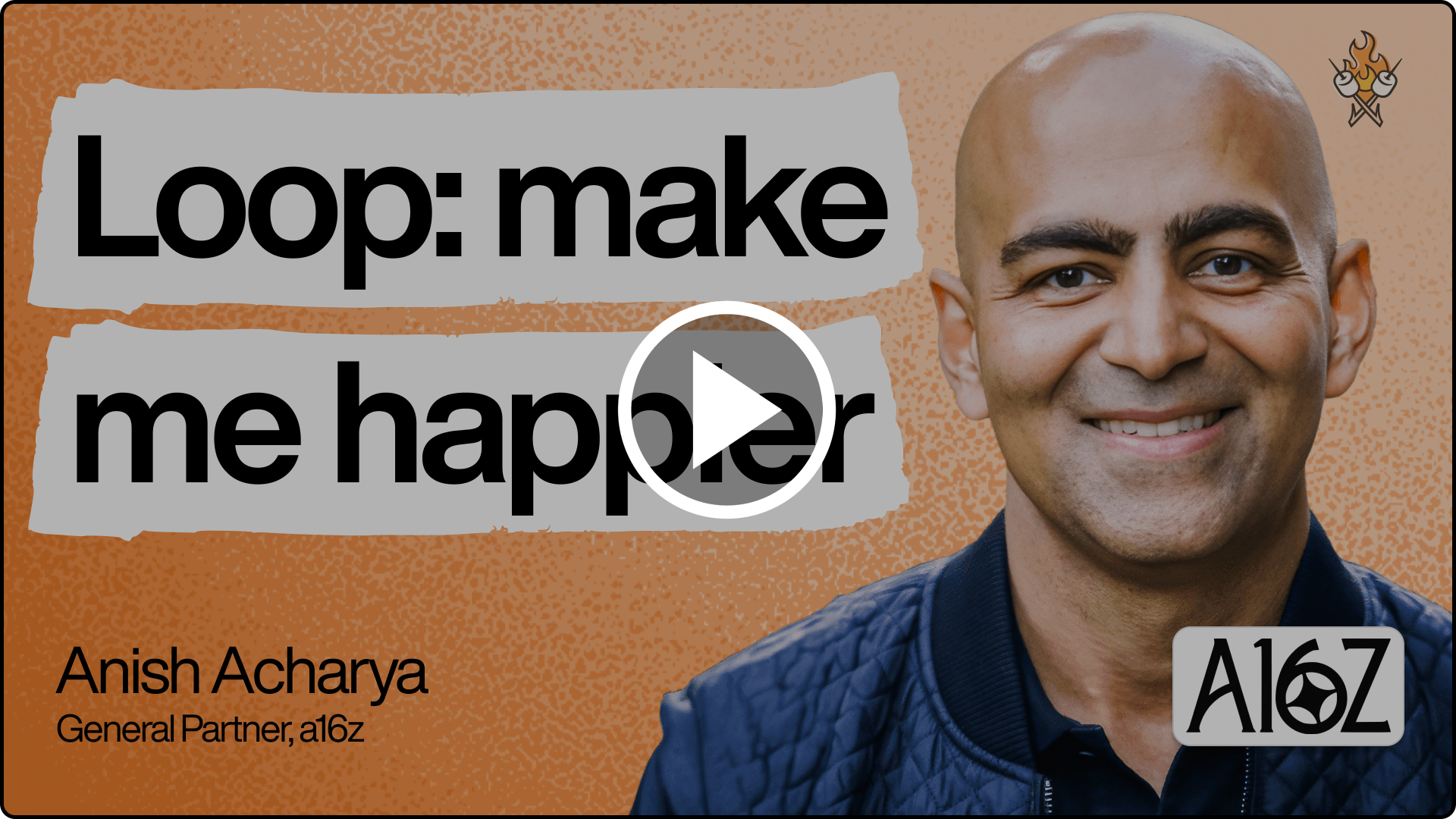
Why companies are becoming a series of loops | Anish Acharya (a16z) thumbnail

Why companies are becoming a series of loops | Anish Acharya (a16z)

Published 6 Sept 2026

Duration: 01:19:24

"AI amplifies productivity and ambition by automating tasks, preserving human creativity, and fostering innovation, while advocating for emotionally intelligent tech and urging experimentation to build intuition and tackle global challenges."

Episode Description

Anish Acharya is a General Partner at Andreessen Horowitz (a16z), where he has focused on consumer investing. Anish is one of the most insightful, tho...

Overview

The podcast discusses the transformative impact of AI on work, creativity, and human experience, emphasizing its role as an amplifier of human ambition rather than a replacement for it. A central theme is the shift from fearing AI-driven job displacement to embracing its potential to enhance productivity through "loops" - automated workflows where AI handles repetitive tasks while humans focus on strategy, innovation, and emotional intelligence. The discussion highlights how companies are reorganizing around AI, with ambitious organizations redesigning operations for rapid iteration and growth, while employees across roles increasingly adopt AI tools to gain leverage and improve outcomes.

Beyond business applications, the conversation explores AI's potential to fulfill deeper human needs - such as connection, happiness, and personal growth - by enabling products that go beyond time-saving to enrich quality of life. Examples include using AI for sentimental projects like personalized gifts or measuring meaningful interactions between family members. The podcast also examines product design challenges in consumer AI, advocating for playful experimentation, better user interfaces, and pricing models that reflect real value. Ultimately, the focus is on building systems where AI supports human agency, encourages 10x thinking, and unlocks new forms of creativity and fulfillment across domains like music, education, and social interaction.
What If

  • What if you built a personal AI loop that measures and improves your happiness daily?

    • Move: Design a simple agent loop using an open-weight model (e.g., Llama 3) to log daily interactions, flag moments of connection or joy, and suggest one small action to increase emotional well-being (e.g., call a friend, replay a positive memory). Integrate with journaling tools via API.
    • Why Now?: Open-weight models have dropped in cost and latency, making continuous personal loops feasible; consumer AI is still pre-paradigm (like iPhone 2010), so first movers can define the category.
    • Expected Upside: You validate a "make me happier" loop that could evolve into a standalone product - especially valuable as people seek meaning beyond productivity, and startups outpace incumbents in socially experimental tech.
  • What if you audited every task you do for a week and replaced at least three with AI agents - then productized one failure?

    • Move: Use AI (e.g., Cursor, Claude) to automate routine work (bug fixes, email triage, meeting notes), document where it fails, then build a micro-SaaS around one gap (e.g., an AI assistant that escalates only when stuck, captures your fix, and learns from it).
    • Why Now?: Companies like Kvac are already training non-tech workers in AI; the shift from "can it work?" to "how fast can we iterate?" favors solo devs who treat failures as data.
    • Expected Upside: You create a real-world "agent sommelier" skillset - knowing which model fits which task - and ship a niche tool that reflects actual human-AI collaboration bottlenecks, giving you a durable edge over generic automation apps.
  • What if you launched a $1,000/month version of your current product - even if just as a prototype - to force ambition?

    • Move: Redesign your existing tool (e.g., a coding helper, content generator) as a high-touch, high-output service: bundle AI loops with human oversight, private models, and outcome guarantees (e.g., "ship 10 verified features/month"). Offer it to three clients at that price.
    • Why Now?: The market has shifted - from avoiding "too ambitious" to fearing "too small"; enterprises now sign million-dollar AI contracts without full clarity, proving appetite for outsized value.
    • Expected Upside: You escape the race-to-the-bottom pricing trap, uncover hidden willingness to pay, and position yourself as a premium builder - validating whether your product solves a high-upside, verifiable problem worth frontier-model spend.

Takeaway

  • Implement AI-driven loops for repetitive tasks like bug fixes or customer feedback processing to accelerate product iteration and reduce manual overhead.
  • Adopt a "ship weekly" heuristic to build momentum, gain practical insights, and refine ideas through real-world execution rather than theoretical planning.
  • Focus on high-ambition product design by prototyping premium versions (e.g., $1,000/month) to validate value perception and uncover underserved market needs.
  • Use open-weight AI models for cost-sensitive, bounded-upside tasks (e.g., documentation, internal tools) to achieve Pareto-efficient performance without overpaying for frontier capabilities.
  • Regularly experiment with new AI models on small, low-stakes projects (e.g., personal tools, creative content) to develop intuitive model selection skills and discover novel use cases.

Recent Episodes of Lenny's Podcast: Product, Career, Growth

More Lenny's Podcast: Product, Career, Growth episodes