More The Pragmatic Engineer episodes

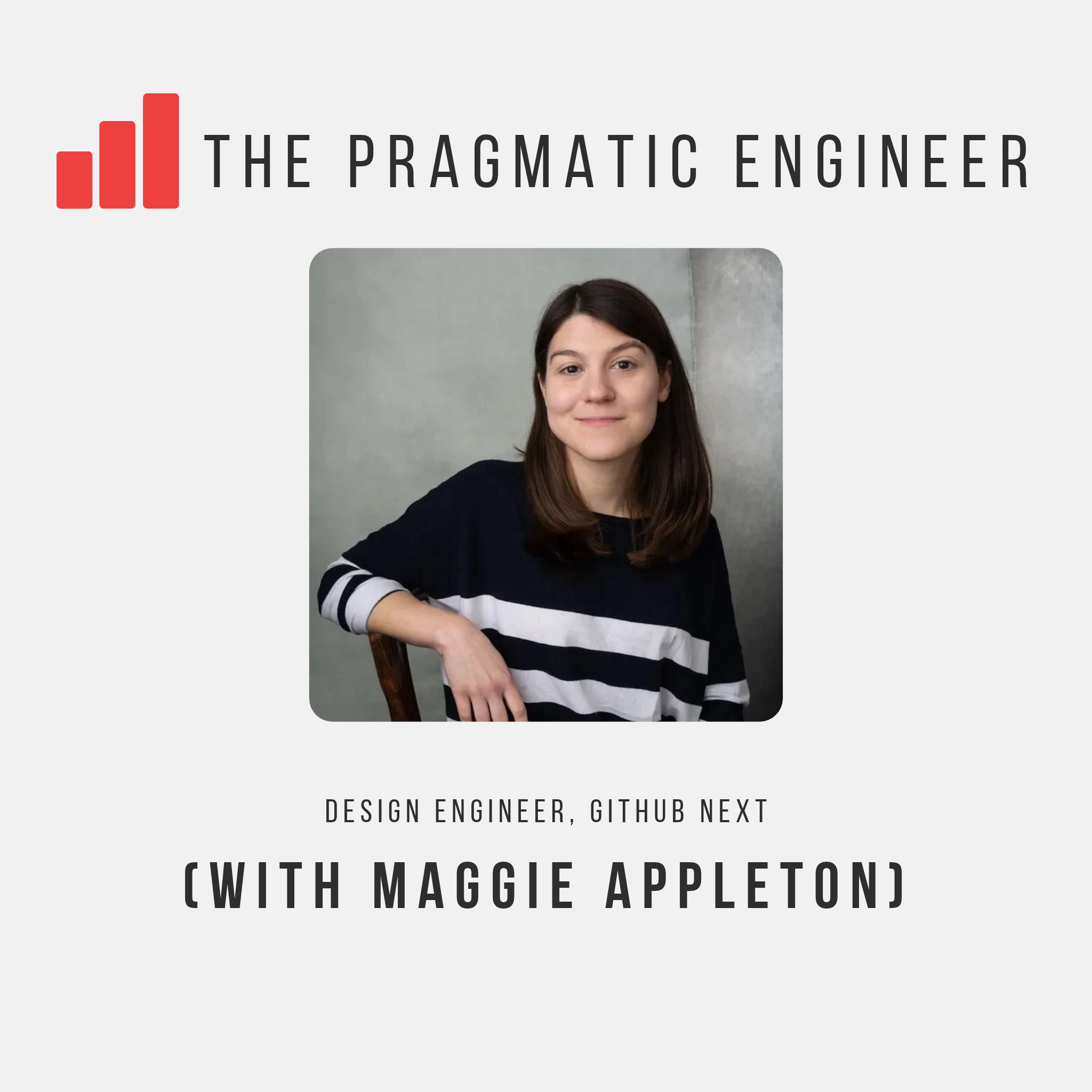
Design Engineering with Maggie Appleton thumbnail

Design Engineering with Maggie Appleton

Published 23 Sept 2026

Duration: 01:27:23

"Explores the evolving role of design engineers, blending engineering and design principles, analog tools, AI, and interdisciplinary collaboration to shape intuitive, culturally aware digital experiences."

Episode Description

Brought to You By:* turbopuffer - a vector and full-text search engine built on object storage. It's fast, cheap, and extremely scalable.* O'Reilly Ea...

Overview

The podcast explores the evolving role of design engineers and the intersection of design and software engineering, emphasizing the importance of collaboration between disciplines. It discusses how designers and engineers share problem-solving approaches, though they work with different materials - designers focusing on visuals, interactions, and user flows, while engineers handle code and system architecture. The tension between high-fidelity mockups and technical implementation is examined, with criticism of design tools like Figma for lacking awareness of engineering constraints. The rise of AI in design is analyzed, highlighting its ability to generate prototypes and assist in coding, yet underscoring limitations in spatial reasoning, creativity, and contextual judgment.

A significant portion of the discussion centers on the impact of AI agents on design and development workflows. While AI accelerates tasks like prototyping and implementation, challenges remain in team alignment, decision-making, and maintaining human oversight. The podcast examines experimental tools that enable real-time, multiplayer collaboration with AI, aiming to bridge the gap between individual productivity and team-based software development. Additionally, broader themes include the value of analog methods like sketching, the cultural and anthropological influences on design thinking, and the potential for democratized software creation through "barefoot developers" using AI to build custom, local-first applications. The conversation ultimately advocates for a balanced, human-centered approach to design in an increasingly AI-driven landscape.
What If

  • What if you prototyped user workflows with pen and paper before touching code?

    • Move: For your next feature, sketch the full user journey on paper - nouns, verbs, screens, decisions - then digitize only after validation with a colleague or user.
    • Why Now?: AI tools make digital prototyping fast, but they skip the cognitive benefits of low-fidelity sketching, which reduces overfitting to tools like Figma and surfaces edge cases earlier.
    • Expected Upside: Catch 30 - 50% of flow issues pre-implementation, reduce rework, and accelerate alignment with stakeholders through clearer, constraint-free ideation.
  • What if you offloaded UI implementation to AI agents but owned the design system logic?

    • Move: Define a living design system (spacing, typography, component verbs) in a markdown doc; use AI to generate code from sketches, then audit PRs for adherence.
    • Why Now?: AI can now render pixel-perfect UIs from specs, but lacks judgment on consistency and cognitive load - your role shifts from builder to quality gatekeeper.
    • Expected Upside: 2x faster iteration on UI changes, maintainable design coherence, and free up 10+ hours/month for higher-level product thinking.
  • What if you built a "barefoot dev" tool for a niche personal need and shared it publicly?

    • Move: Identify a repetitive personal task (e.g., expense tracking, content curation), build a minimal app using AI + no-code/low-code tools, and publish it as a "digital garden" prototype.
    • Why Now?: Language models and local-first frameworks (e.g., SQLite, Tauri) now enable solo operators to ship secure, custom tools without backend expertise.
    • Expected Upside: Validate product-market fit with zero marketing, attract early users or collaborators, and establish authority in a micro-niche with low competition.

Takeaway

  • Sketch early ideas on paper or a whiteboard before using digital tools to rapidly explore and refine concepts without the constraints of high-fidelity mockups, improving clarity and reducing rework.

  • Use AI agents to generate multiple design or code variations quickly, then manually curate and refine them to maintain control over quality, nuance, and user experience.

  • Collaborate with engineers early by prototyping in the browser, not just in Figma, to align on technical feasibility and create more realistic, implementable designs.

  • Define clear "nouns and verbs" for your product's domain (e.g., what users interact with and what actions they can take) to create intuitive, coherent interfaces - especially for complex or novel tools.

  • Build and share small, functional prototypes or "homecooked software" for personal or niche use, leveraging AI and no-code tools to validate ideas and meet specific needs without relying on commercial platforms.

Recent Episodes of The Pragmatic Engineer

29 Oct 2026 Software engineering at Google & CS education with Titus Winters

"Critiques CS education, advocating for AI-informed, practical curricula focused on problem-solving, teamwork, and real-world development, while examining Google's engineering practices, productivity challenges, and the need for deterministic tools in AI-driven software engineering."

21 Oct 2026 The revised rules of engineering management with Will Larson

"Engineering management is evolving, with outdated 2010s practices giving way to business-focused problem-solving, AI-driven role shifts, and adaptable leadership that prioritizes high-ownership teams and reskilling for long-term success."

7 Oct 2026 Building resilient systems with Sam Newman

Recommended: Good Engineering Decisions

"Microservices are a last-resort architecture requiring careful state management, while resilient systems depend on robustness, rebound, extensibility, and adaptability, with AI augmenting but not replacing human oversight in development."

30 Sept 2026 Distributed databases with Peter Mattis

"Software engineer and Cockroach Labs co-founder Peter Mattis discussed his career in database design, distributed systems, AI's impact on development, and the evolution of his leadership role, stressing rigorous testing, security, and the transformative potential of AI in coding."

17 Sept 2026 AI Skills with Matt Pocock

"Former voice coach turned developer shares insights on AI integration in software engineering, emphasizing fundamentals, adaptability, and structured workflows for productivity."

More The Pragmatic Engineer episodes