More Cyb3rSyn Labs Podcast episodes

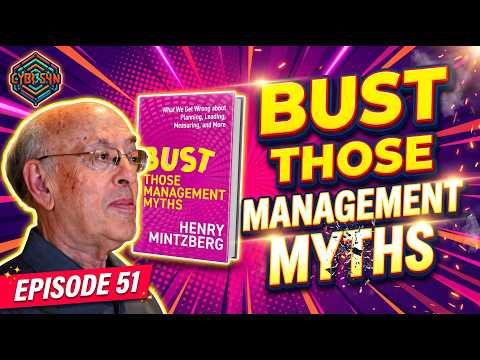
Bust Those Management Myths: Henry Mintzberg thumbnail

Bust Those Management Myths: Henry Mintzberg

Published 25 Oct 2026

Duration: 00:54:04

"Strategic planning should prioritize adaptability and communityship over rigid hierarchies, as outdated management myths and over-reliance on metrics hinder innovation and effective leadership."

Episode Description

Cyb3rSyn Labs Podcast - Episode 51 In this episode, renowned management expert Henry Mintzberg discusses his book "Bust Those Management Myths," chall...

Overview

The podcast discusses fundamental critiques of traditional management practices, emphasizing that strategic planning is often an oxymoron - real strategies emerge through experience and adaptation rather than being rigidly formulated in boardrooms. It highlights the dangers of over-reliance on measurement, arguing that metrics like share price fail to capture true organizational health and can undermine effectiveness when prioritized over human judgment and qualitative insights. The discussion also explores how innovation is often driven by intuition and serendipity, particularly in entrepreneurial settings, but tends to be stifled as companies grow and shift toward analytical, process-driven management.

A central theme is the importance of communityship - fostering a shared sense of ownership and belonging within organizations - as a counterbalance to hierarchical leadership models that erode trust and collaboration. The conversation critiques bureaucratic inefficiencies, remote work's impact on organic interaction, and the limitations of applying one-size-fits-all organizational models, noting that different types of organizations (e.g., professional assemblies, project-based pioneers) require distinct management approaches. It further warns against the dehumanizing effects of excessive automation and AI in customer service and decision-making, advocating for a balanced integration of technology that preserves human judgment, creativity, and connection.
What If

  • What if you stopped creating long-term strategic plans and started running quarterly "emergent strategy sprints" instead?

    • Move: Cancel your annual roadmap planning. Replace it with a 3-day solo sprint every quarter where you review real user behaviors, support logs, and unexpected usage patterns - then adjust your next 90-day priorities based on what actually emerged.
    • Why Now?: Strategic planning fails when it's detached from reality; solo developers can adapt faster than teams but often overcommit to rigid plans. The agility you have is wasted if you're locked into a year-long vision no one asked for.
    • Expected Upside: You'll ship features users actually need, reduce wasted effort by 30 - 50%, and increase product-market fit through continuous alignment with real-world feedback instead of assumptions.
  • What if you replaced all vanity metrics with one "soul check" to assess your product's health?

    • Move: Delete your dashboards tracking DAUs, MRR growth, or session duration. Replace them with a weekly ritual: record a 5-minute video of yourself using your product end-to-end as a real customer would - struggles, confusion, and all - and rate how "alive" the experience feels.
    • Why Now?: Over-reliance on measurable metrics blinds you to qualitative decay. As a solo operator, you're close enough to feel when something's off - but only if you stop hiding behind numbers.
    • Expected Upside: You'll catch UX rot early, maintain emotional connection to your users, and avoid optimizing for growth while losing the soul of your product - preserving long-term sustainability over short-term spikes.
  • What if you treated your business as a professional assembly, not a program machine?

    • Move: Audit your workflows and eliminate any process that prioritizes efficiency over effectiveness (e.g., auto-replies, canned support responses, AI-generated emails). Replace them with manual, human-first interactions - even if slower - for the next 60 days.
    • Why Now?: Most solopreneurs mimic corporate efficiency tactics that kill adaptability and insight. Your advantage is being human, not scalable. If you automate too soon, you lose the serendipity that leads to breakthroughs.
    • Expected Upside: You'll uncover hidden user needs through direct conversation, build stronger customer loyalty, and generate unexpected feature ideas that no KPI-driven system would surface - fueling organic growth through communityship, not churn.

Takeaway

  • Audit your current business processes to identify and eliminate unnecessary bureaucracy that slows down execution, especially any procedures introduced without clear purpose or feedback from actual use.
  • Replace rigid strategic planning with an emergent strategy approach by running small experiments, observing outcomes, and adapting your product or service direction based on real-world feedback rather than top-down forecasts.
  • Use your own product or service regularly as a customer would, document pain points (e.g., difficulty with packaging, navigation, or onboarding), and prioritize fixes that improve the actual user experience.
  • Balance metrics with judgment by tracking key data (e.g., revenue, engagement) but making final decisions based on qualitative insights, intuition, and direct observation - especially when data conflicts with user or market reality.
  • Foster communityship in your solo operation by building genuine relationships with customers and collaborators through consistent, human-centered communication - avoid over-automating interactions where empathy and trust matter most.

Recent Episodes of Cyb3rSyn Labs Podcast

4 Oct 2026 The Trouble With Business Leadership: Bob Emiliani (Part 1)

"Critiques classical management for prioritizing hierarchy and profit over human value, advocating for progressive principles like respect, systems thinking, and Toyota's flow-based efficiency, while exposing systemic resistance to change."

27 Sept 2026 Organizational Dysfunctions: Trond Hjorteland (Part 2)

"Workplace disengagement stems from rigid frameworks, top-down management, and misapplied metrics, requiring contextual adaptation, autonomy, and meaningful work to foster fulfillment and combat systemic dysfunctions."

20 Sept 2026 Organizational Dysfunctions: Trond Hjorteland (Part 1)

"Examining organizational coordination, the podcast critiques top-down vs. bottom-up authority, resistance to change, and systemic dysfunctions, while emphasizing the influence of STS, OST, and self-managing teams - highlighting historical parallels, design principles, and the critical role of social cohesion in team performance."

6 Sept 2026 Systems Practice: Patrick Hoverstadt

"Systems thinking offers a framework for tackling complexity and uncertainty, integrating insights from *Viable Systems Modeling* and thinkers like Gregory Bateson, while addressing challenges like bias, adaptability, and ethical stakeholder balance in dynamic environments, including AI-driven organizational shifts."

9 Aug 2026 Viable Operating Model: Abdul Aziz (Part 2)

"Explores systemic tensions, mechanistic pitfalls, and dynamic approaches to align actions with values, emphasizing adaptability, foresight, and accountability over rigid structures and short-term gains."

More Cyb3rSyn Labs Podcast episodes