12 Nov 2026 If I Wanted to 10x My Revenue in 2027, Id Do This | Matt Trinetti | 154
Scaling a membership business from $500,000 to $5 million requires mastering mission, funnel metrics, retention strategies, product clarity, and LTV to CAC ratios.
More The Nathan Barry Show episodes
Published 22 Oct 2026
Duration: 01:27:33
The podcast explores strategies for building networks and communities, emphasizing the importance of genuine connections and challenging the notion of self-made success.
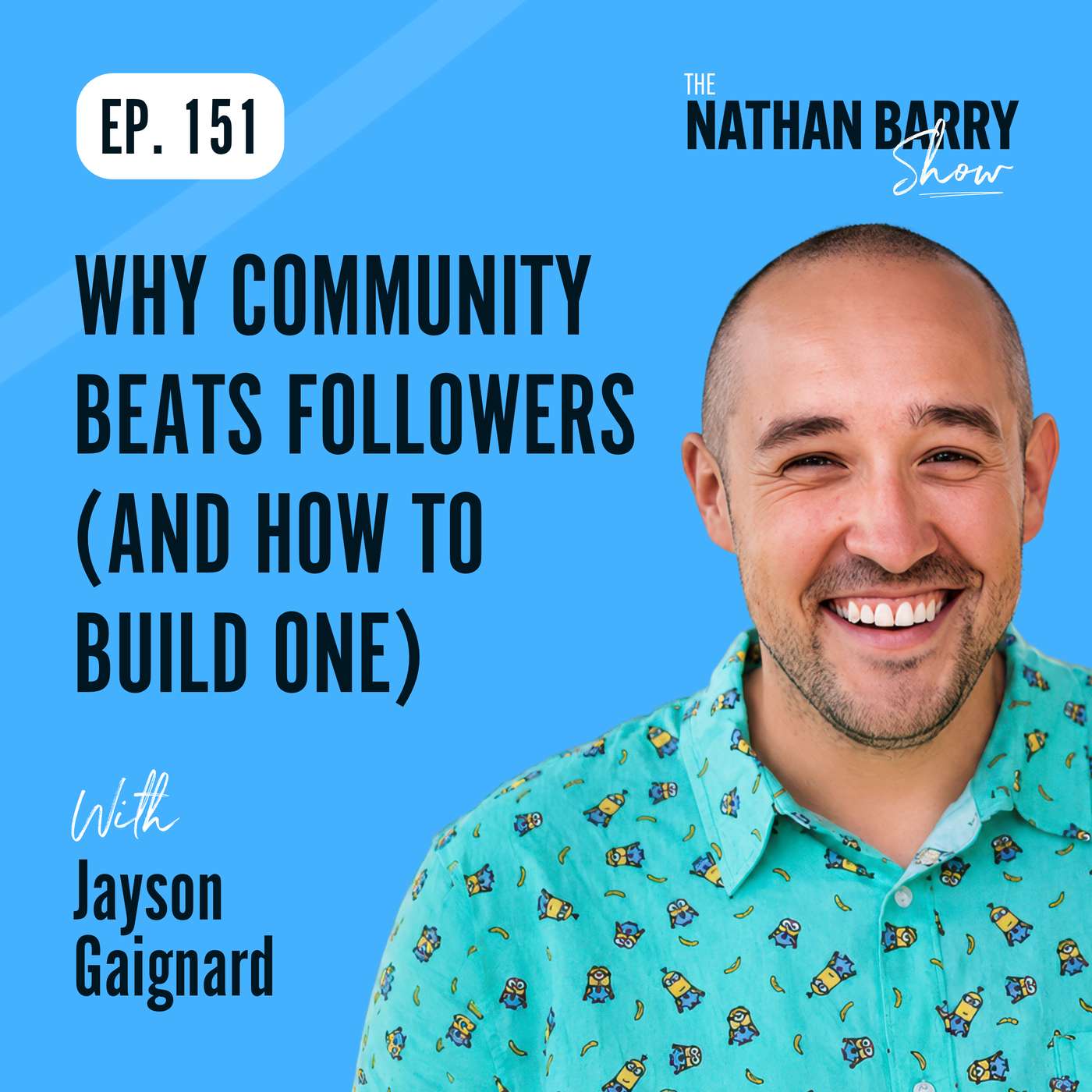
Do you want to know how to get into rooms with people who are several levels above you?Jayson Gaignard is the reason about 50 of my favorite entrepren...
This conversation explores how to build meaningful professional relationships and communities, centered on the philosophy that if you can't get an invite into a room, you can create the room yourself. The discussion covers three pathways to access: money (buying into curated events), moxie (cold outreach and boldness), and service (apprenticing and doing heavy lifting for others). A key distinction is drawn between building a fan base and building a community, where the latter creates value that persists even when the organizer is absent.
The conversation examines how to curate groups effectively, using strategies like the "anchor tenant" principle (securing one high-profile participant to attract others) and sequential outreach (starting with the easiest person and building momentum toward the hardest). It also addresses the hierarchy of relationship environments - from open conferences to criteria-based professional organizations to curated masterminds and value-aligned communities - explaining how trust and vulnerability accelerate in more tightly curated spaces.
A recurring theme is that doing great work elevates every other networking effort, functioning as a conversion rate multiplier. The discussion extends to practical systems like "friends only" email updates, the ask-give-praise community model, and the concept of increasing one's "surface area of luck" by combining excellent work, visibility, and deep relationships.
What if you created your own room by organizing a small dinner for eight people in your software niche, starting easiest and working toward the hardest?
What if you sent a "friends only" update email to a small group in your professional circle, including one ask and a short video?
What if you adopted "leaving energy" at your next conference, meetup, or virtual networking call, limiting yourself to 45 seconds?
12 Nov 2026 If I Wanted to 10x My Revenue in 2027, Id Do This | Matt Trinetti | 154
Scaling a membership business from $500,000 to $5 million requires mastering mission, funnel metrics, retention strategies, product clarity, and LTV to CAC ratios.
5 Nov 2026 How to Grow and Monetize a Newsletter in 2027 (Full Strategy) | Chenell Basilio | 153
Five key levers for newsletter growth include valuable content, clear positioning, focused distribution, optimized conversion, and enhanced subscriber experience.
15 Oct 2026 AI Can't Copy This: Why Every Creator Needs an Origin Story in 2026 | Philip McKernan | 150
Sharing personal stories, especially origin stories, can help connect authentically and find purpose, with one's greatest gift often lying next to their deepest wound.