9 Sept 2026 1037: WebMCP is here (and you should care)
"WebMCP enables AI agents to interact directly with web apps via browser-based protocols, improving efficiency, security, and collaboration across platforms."
More Syntax - Tasty Web Development Treats episodes
Published 9 Mar 2026
Duration: 2828
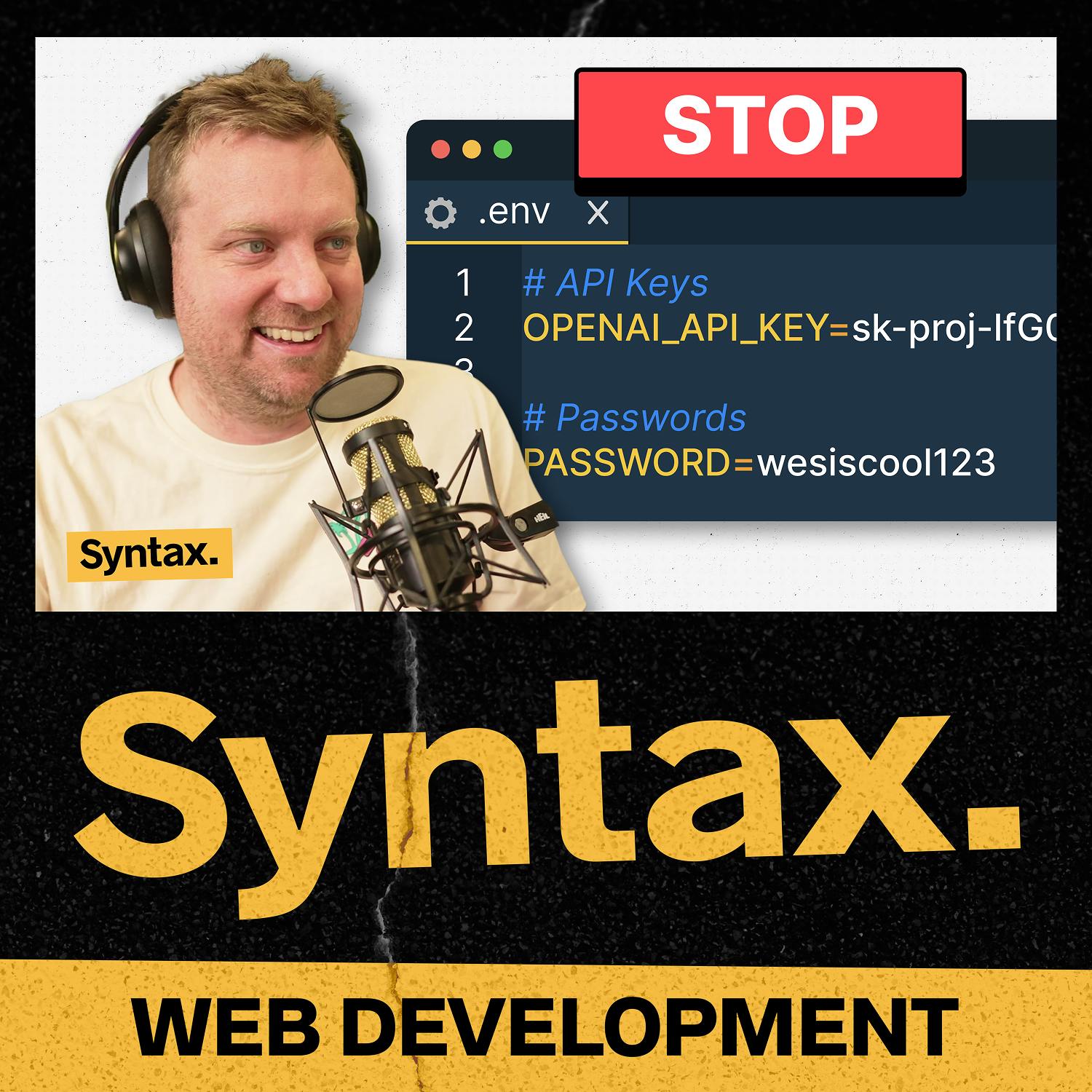
The drawbacks of using .env files for environment variable management are discussed, and a solution called Varlok is introduced as a unified configuration system that addresses these issues.
Scott and Wes are joined by Phil Miller and Theo Ephraim to talk about Varlock, a new approach to environment variables that adds schemas, validation,...
The podcast explores the limitations of using .env files for managing environment variables, emphasizing security risks such as accidental exposure of sensitive data, challenges in maintaining consistency across codebases, and confusion between placeholder values and actual configurations. These issues are compounded by the lack of standardization and the difficulty of synchronizing changes across development, testing, and production environments. Despite these drawbacks, .env files remain widely used due to their simplicity, prevalence in tutorials, and the perceived cost or complexity of alternative solutions.
The discussion introduces Varlok as a proposed solution that addresses these challenges by centralizing configuration through schema-based definitions, enforcing type safety, and separating sensitive data for secure management. Varlok supports environment-specific configurations, integrates with multiple secret management systems, and ensures compatibility with frameworks like Next.js. It emphasizes validation, error handling, and reduces boilerplate code, offering benefits such as improved team collaboration, scalability for multi-cloud environments, and mitigation of risks associated with misconfigured or misused environment variables.
9 Sept 2026 1037: WebMCP is here (and you should care)
"WebMCP enables AI agents to interact directly with web apps via browser-based protocols, improving efficiency, security, and collaboration across platforms."
5 Aug 2026 1027: The Rise of the Design Engineer
"Design engineers merge creativity and technical skills to build functional solutions, facing biases in tech while emphasizing human judgment over AI-generated aesthetics, environmental concerns, and practical coding tips."
29 Jul 2026 1025: The Open Web's second chance (w/ Dan Abramov)
"ATProto is a decentralized data layer enabling users to own and control their data across apps, solving walled gardens and interoperability issues with a standardized, JSON-based system and web-native identity."
22 Jul 2026 1023: Mosh, Caddy & Tailscale: A Remote Dev Deep Dive
"Remote development workflows offer benefits like continuous processing and multi-device access but face challenges like rogue processes and secure local environment exposure, with tools like Tmux, Herder, and Tailscale discussed for managing sessions and networking."
20 Jul 2026 1022: Bun re-written in Rust, Zig team big mad
"TypeScript 7.0 delivers a 10x speed boost, network upgrades include 2G speeds and SFP fiber, AI updates cover GPT 5.6 and Grok concerns, while tech news highlights acquisitions, language releases, and personal tech setups."