More Syntax - Tasty Web Development Treats episodes
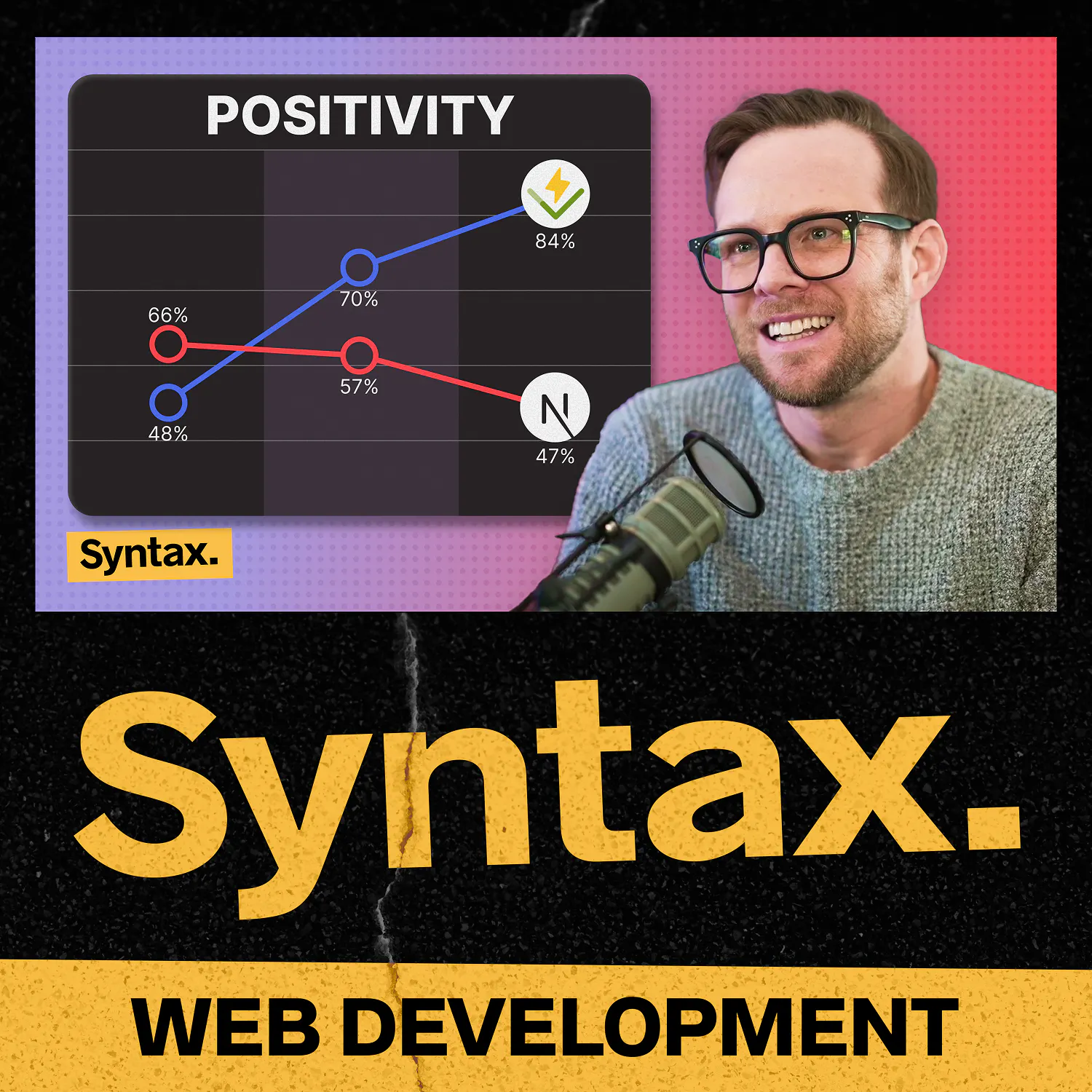
989: State of JS 2025 thumbnail

989: State of JS 2025

Published 23 Mar 2026

Recommended: Notes from the wisdom of the crowd of JavaScript developers.

Duration: 3844

Recent JavaScript/web dev trends highlight AI integration over new language features, shifting library preferences (React/Angular decline vs. Solid/Playwright rise), performance-focused tools like Vitest and Node.js, and growing emphasis on simplicity, observability, and hybrid development approaches.

Episode Description

Scott and Wes dig into the latest State of JS survey results, breaking down which JavaScript libraries, frameworks, and tools are rising, falling, or...

Overview

The text discusses evolving trends in JavaScript features, libraries, and developer tools over the past decade. JavaScript has seen advancements in APIs and immutable functions, but developer attention is increasingly diverted by AI trends, reducing focus on newer language capabilities. Library adoption follows a backward C pattern, with frameworks like React, Express, and Webpack losing sentiment over time. Exceptions include Solid, which gains traction with an S curve due to its appeal as a React alternative, and Playwright and VTest, which rise in popularity for performance and AI integration. Webpack faces criticism, while Svelte and Solid are compared as alternatives, with Solid noted as more mature for specific use cases. Developer sentiment reveals a growing preference for tools balancing performance, simplicity, and AI capabilities, with advanced users exploring alternatives like Vite, Astro, and Playwright over traditional choices like Next.js or Angular.

Backend frameworks like Express remain dominant despite criticism for complexity, while emerging tools like Hano and 10sec Start gain traction. AIs influence is evident in tool recommendations, such as Playwright and Vite displacing older frameworks like Mocha and Cypress, and in schema validation tools like Zod seeing increased adoption. Astro surpasses Svelte Kit in usage, though its niche appeal remains limited. Static site generators face decline as developers shift toward hybrid static-dynamic approaches. Observability tools like Century.io are highlighted for tracking AI model performance and optimizing costs. Meanwhile, tools like ESLint and Prettier retain dominance in code formatting, with newer options like Biome and Oxlin gaining incremental traction.

The text also addresses tools like Bun, a Node.js alternative criticized for instability, and VS Codes continued dominance in editor usage, contrasting with niche preferences for Sublime Text and experimental options like Fleet. AI-generated code and tool recommendations are reshaping workflows, with frameworks like Next.js facing criticism for complexity despite its popularity. Surveys reveal cyclical sentiment patterns, with frameworks like Angular and Gatsby showing declining satisfaction over time. Key themes include the shift toward lightweight, AI-integrated tools, growing dissatisfaction with legacy systems, and a fragmented landscape where niche solutions (e.g., Ripple, Hono) are gaining attention for their innovation and efficiency.

Final Notes

The provided text is a long and detailed analysis of various trends, insights, and takeaways from a survey of JavaScript and web development communities. Here are some key insights and takeaways:

  1. Trends in JavaScript features: The survey highlights the evolution of JavaScript features over the past six to seven years, including the introduction of immutable array functions. However, the increasing distraction caused by AI trends may divert focus from newer language features.
  2. Library Adoption Curves: Many popular libraries, such as React and Express, follow a "backward C" trend, where popularity initially increases and then decreases over time. However, exceptions like Solid, VTest, and Playwright show different trajectories, gaining popularity despite lower usage.
  3. Tooling and Bundling Tools: Webpack has significant negative sentiment due to its heavy criticism. VTest, in contrast, is praised for its speed and simplicity, while Playwright is regaining traction with AI-driven automation.
  4. Developer Sentiment and Preferences: Advanced developers tend to explore alternatives to popular choices like React, while the survey highlights a growing interest in tools that balance performance, simplicity, and AI integration.
  5. Survey Overview and Trends Over Time: The longitudinal data from 2016 to 2025 shows changes in tool popularity and sentiment over time. Angular, for instance, initially had great positivity but saw a decline in user satisfaction and popularity.
  6. Angular and Gatsby Patterns: Angular dominated early in the 2010s but declined due to complexity issues in large-scale projects. Gatsby, a static site generator, also faces scalability and deployment challenges.
  7. Library Tier List Analysis: The tier rankings show that Vite, Playwright, and Astro are top-level libraries, while Next.js, Angular, and Gatsby are in the lower tier due to pain points like flaky tests and complex configurations.
  8. Testing Tools Trends: Playwright and Vite are rising in popularity for testing, while legacy tools like Mocha and Cypress face criticism for being outdated and flaky.
  9. Usage and Sentiment Patterns: Tools like Angular show a "backward C" curve, while others like Solid follow an "S" curve, with a slow start and then rapid growth.
  10. Pain Points in Modern Frameworks: Modern frameworks face issues like excessive complexity, which leads to difficulty in adoption and usage.
  11. Decline of Static Site Generators: Developers are shifting away from static site generators like Gatsby and Jekyll, opting for hybrid approaches that balance static and dynamic content.
  12. Rise of Meta Frameworks: Meta frameworks like Next.js and Svelte Kit are gaining popularity due to their ability to simplify development and improve performance.
  13. Testing Ecosystem Shifts: The testing ecosystem is shifting towards more modern and efficient tools like Playwright and Vite.
  14. Schema Validation and Libraries: Zod is gaining traction in schema validation due to its simplicity and TypeScript compatibility.
  15. JavaScript Runtimes: Node.js remains the dominant runtime, but Bun is gaining popularity, though it faces issues with stability and cross-platform reliability.
  16. AI Influence on Tech Choices: AI tools like Sonnet and Opus are influencing tech choices by recommending different ORMs and tooling.
  17. Cloud Code Stack: AI-driven tools like Amplify are shaping tech stacks by suggesting tools for styling, hosting, and error monitoring.
  18. Pain Points & Developer Perspectives: Migration challenges, AI-generated code, and trend dynamics are major pain points for developers.
  19. Observability Tools and AI Monitoring: Century.io is a notable observability tool that provides real-time monitoring and error tracking.
  20. Testing Frameworks and Tools: Vitest is rising in popularity due to its simplicity and compatibility with existing test suites.
  21. Schema Validation and Libraries: Zod is gaining traction in schema validation due to its simplicity and TypeScript compatibility.
  22. JavaScript Runtimes: Node.js remains the dominant runtime, but Bun is gaining popularity, though it faces issues with stability and cross-platform reliability.
  23. AI Influence on Tech Choices: AI tools like Sonnet and Opus are influencing tech choices by recommending different ORMs and tooling.
  24. Cloud Code Stack: AI-driven tools like Amplify are shaping tech stacks by suggesting tools for styling, hosting, and error monitoring.
  25. Trends in JavaScript libraries and tools: Libraries like Three.js and Chart.js continue to dominate their niches, though competitors are emerging.
  26. Code Linters and Formatters: ESLint and Prettier remain widely used, but newer alternatives like Oxlin and Biome are gaining traction.
  27. JavaScript Runtimes: Node.js remains the dominant runtime, but Bun is gaining popularity, though it faces issues with stability and cross-platform reliability.
  28. AI Influence on Tech Choices: AI tools like Sonnet and Opus are influencing tech choices by recommending different ORMs and tooling.
  29. Cloud Code Stack: AI-driven tools like Amplify are shaping tech stacks by suggesting tools for styling, hosting, and error monitoring.
  30. Pain Points & Developer Perspectives: Migration challenges, AI-generated code, and trend dynamics are major pain points for developers.

Overall, the survey highlights the evolution of JavaScript features, trends in library adoption, and pain points in modern frameworks. It also showcases the rise of meta frameworks, testing ecosystem shifts, and the influence of AI on tech choices.

Recent Episodes of Syntax - Tasty Web Development Treats

30 Mar 2026 991: Vites bet on Cloudflare (VOID Framework)

Void is a full-stack JavaScript framework integrated with Cloudflare, offering databases, authentication, and frontend flexibility with React/Svelte/Solid, but faces vendor lock-in concerns, database portability challenges, and trade-offs between Cloudflare ecosystem convenience and platform flexibility.

25 Mar 2026 990: Vite Is Taking Over (Vite+)

Vite+ is an open-source JavaScript toolchain unifying bundlers, linters, and task runners through streamlined configuration, Rust-based Oxlint/Oxformat, and efficiency-focused features like caching and simplified CLI commands, aiming to reduce workflow fragmentation and developer overhead.

18 Mar 2026 988: Cloudflares Next.js Slop Fork

Cloudflare's vNext, a Vite-based Next.js fork, leveraged AI for rapid prototyping and iterative feedback to address porting challenges, while exploring AI's transformative potential in development workflows and framework transitions.

16 Mar 2026 987: Remote Coding Agents

Remote coding agents offer flexibility and productivity by enabling task execution from any device, but face challenges like cost, complexity, and efficiency trade-offs, with potential use cases beyond coding requiring human oversight.

11 Mar 2026 986: Does Code Quality Matter Anymore?

Modern web development topics, challenges, and trends are discussed, including AI's impact, code quality, browser compatibility, and accessibility.

More Syntax - Tasty Web Development Treats episodes