9 Sept 2026 1037: WebMCP is here (and you should care)
"WebMCP enables AI agents to interact directly with web apps via browser-based protocols, improving efficiency, security, and collaboration across platforms."
More Syntax - Tasty Web Development Treats episodes
Published 30 Mar 2026
Duration: 2318
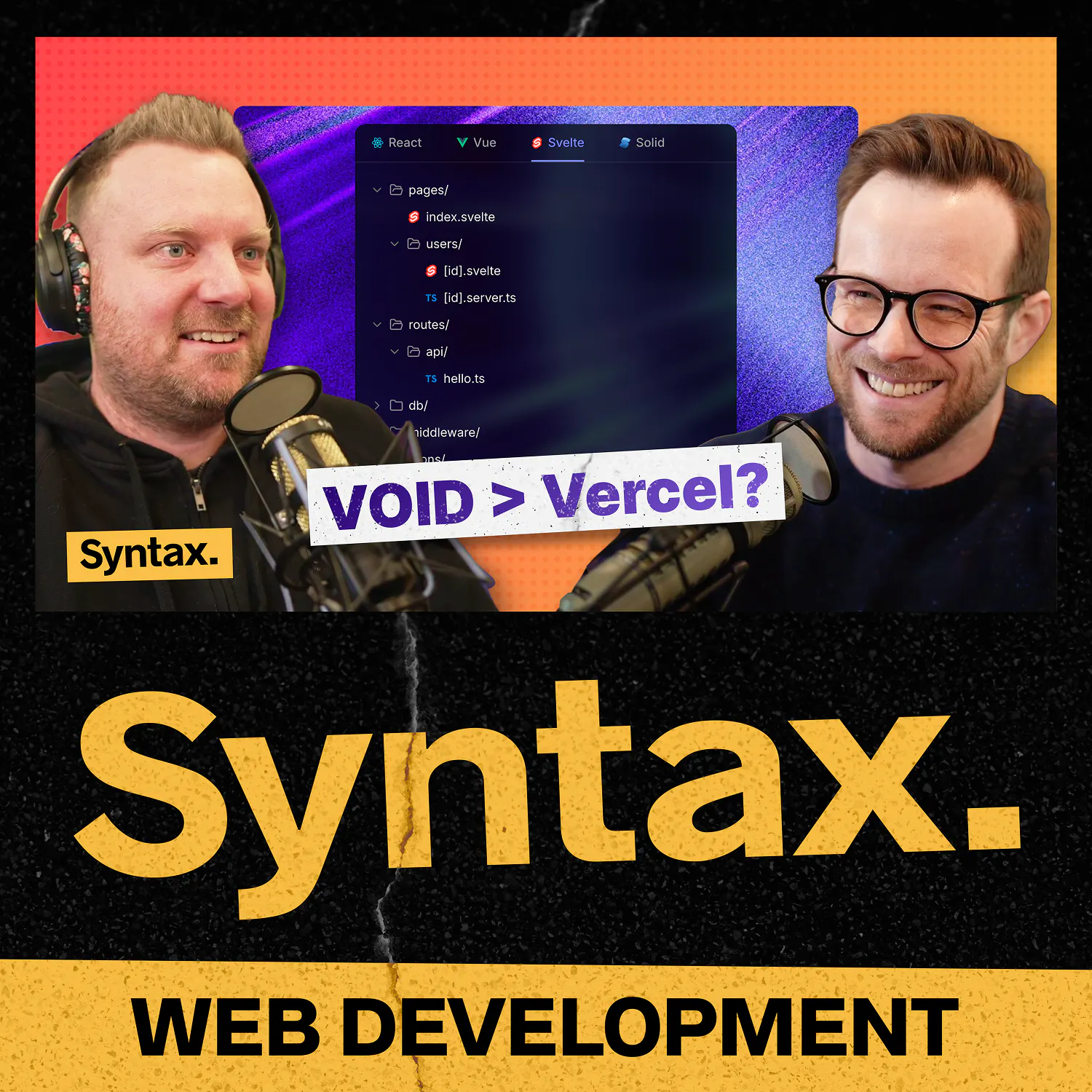
Void is a full-stack JavaScript framework integrated with Cloudflare, offering databases, authentication, and frontend flexibility with React/Svelte/Solid, but faces vendor lock-in concerns, database portability challenges, and trade-offs between Cloudflare ecosystem convenience and platform flexibility.
Vite just launched Void, a fullstack JavaScript framework and cloud platform that bundles together routing, SSR, auth, an ORM, and nearly everything y...
The text discusses Void, a full-stack JavaScript framework developed by Void Zero, alongside its open-source tool Veet Plus. Void functions as a Cloudflare-bound deployment platform and plugin for Veet, offering integrated features like databases, authentication, and server actions to streamline application development. Unlike traditional frameworks like Laravel or Rails, Void provides an ORM and opinionated structure but lacks the extensive convention-driven ecosystems of those frameworks. Key features include full-stack capabilities with built-in tools for queues, caching, and authentication, plus flexible frontend integration with React, Svelte, and Solid. Void positions itself as a meta-framework, combining a unified backend with frontend flexibility akin to Astro, though it emphasizes tailored support for full-stack apps. However, its tight integration with Cloudflare raises concerns about vendor lock-in, despite benefits like seamless access to Cloudflare services. Compatibility with external frameworks like Svelte Kit and Next.js exists but comes with caveats about functionality overlap.
The framework also explores database integration using Drizzle ORM, with Cloudflare D1 as a primary option requiring Hyperdrive for serverless applications due to Cloudflares limitations. Alternatives like Planescale are noted, but challenges persist with local data tools and ecosystem compatibility. Type safety is emphasized, drawing inspiration from SvelteKit to ensure typed data flow across the stack, while API features aim to minimize network hops during server-side rendering. The discussion critiques Next.js for lacking unified API and RPC integration, favoring route-level handling for simplicity. Component-level data fetching is preferred to avoid redundancy, though frameworks lacking streaming or suspense support may face inefficiencies. Tools like Sentry are recommended for error tracking, while RPC-based form actions and schema validation reduce boilerplate. The text also highlights the trade-offs between Cloudflares cohesive ecosystem and vendor lock-in risks, acknowledging that ease of use often comes at the cost of platform dependency. Flexibility is prioritized through adapters for databases and KV stores, allowing partial portability, though Cloudflare-specific tools like Durable Objects pose higher lock-in risks. Developers are encouraged to weigh self-hosting or alternative providers against the convenience of Cloudflares integrated stack.
9 Sept 2026 1037: WebMCP is here (and you should care)
"WebMCP enables AI agents to interact directly with web apps via browser-based protocols, improving efficiency, security, and collaboration across platforms."
5 Aug 2026 1027: The Rise of the Design Engineer
"Design engineers merge creativity and technical skills to build functional solutions, facing biases in tech while emphasizing human judgment over AI-generated aesthetics, environmental concerns, and practical coding tips."
29 Jul 2026 1025: The Open Web's second chance (w/ Dan Abramov)
"ATProto is a decentralized data layer enabling users to own and control their data across apps, solving walled gardens and interoperability issues with a standardized, JSON-based system and web-native identity."
22 Jul 2026 1023: Mosh, Caddy & Tailscale: A Remote Dev Deep Dive
"Remote development workflows offer benefits like continuous processing and multi-device access but face challenges like rogue processes and secure local environment exposure, with tools like Tmux, Herder, and Tailscale discussed for managing sessions and networking."
20 Jul 2026 1022: Bun re-written in Rust, Zig team big mad
"TypeScript 7.0 delivers a 10x speed boost, network upgrades include 2G speeds and SFP fiber, AI updates cover GPT 5.6 and Grok concerns, while tech news highlights acquisitions, language releases, and personal tech setups."