9 Sept 2026 1037: WebMCP is here (and you should care)
"WebMCP enables AI agents to interact directly with web apps via browser-based protocols, improving efficiency, security, and collaboration across platforms."
More Syntax - Tasty Web Development Treats episodes
Published 8 Apr 2026
Duration: 01:00:26
AI in web development faces challenges like generating inefficient CSS, struggling with modern design systems, and producing homogenized or aesthetically poor outputs, requiring human oversight for nuanced creativity, debugging, and balancing AI tools with technical expertise to address performance, security, and design quality gaps.
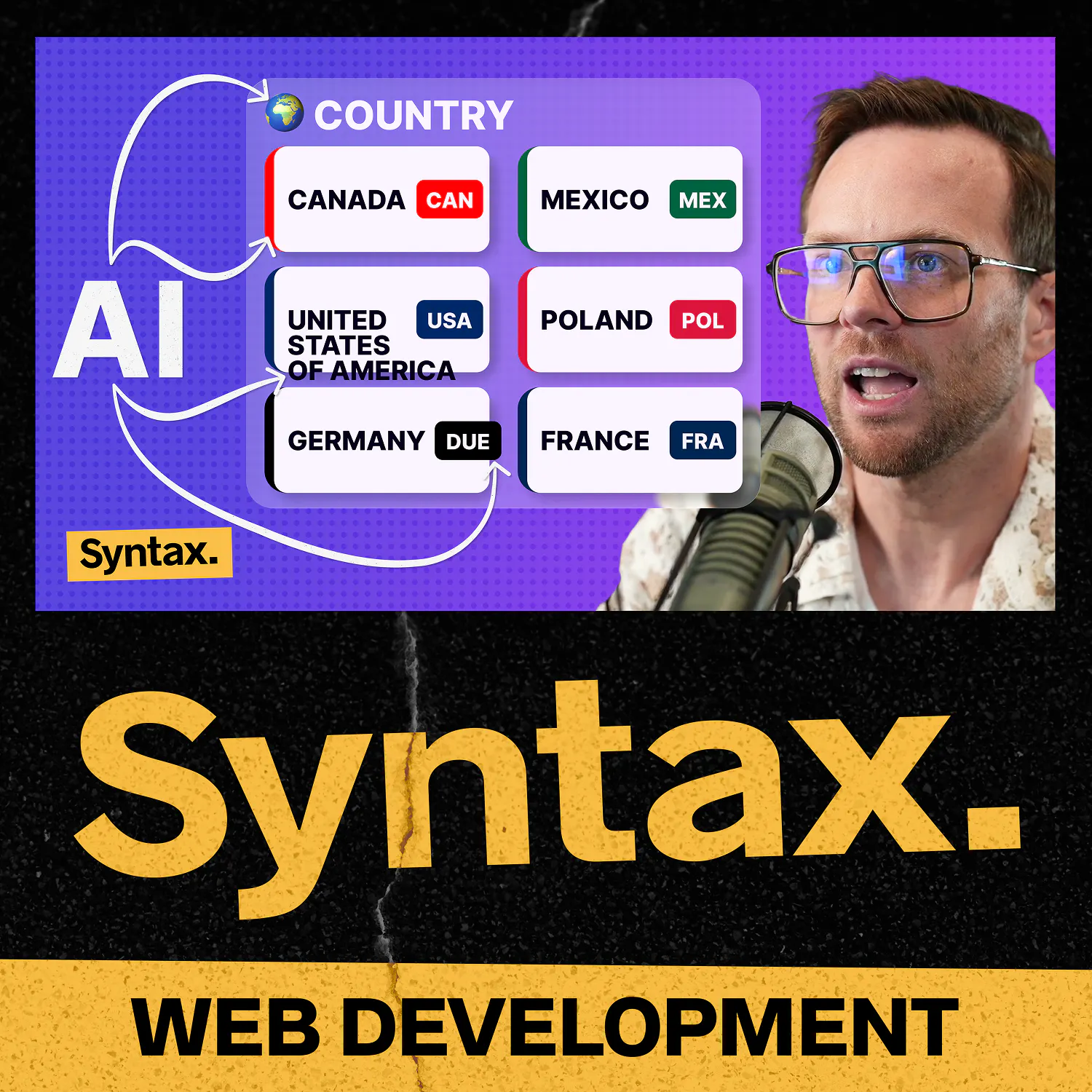
In this potluck episode of Syntax, Wes and Scott answer your questions about AI struggles with CSS and design workflows, learning vs relying on AI, de...
The podcast explores challenges in using AI for web development, particularly its struggles with CSS and design systems. AI often generates inefficient, outdated code, ignoring modern features like nested CSS and introducing unnecessary classes, even when design systems are in place. System prompts in AI models can bias outputs toward homogenized or overly stylized results, while debates persist over whether rigid design rules or subjective "vibe rules" should guide AI-generated designs. Template-based tools, though useful for producing "good-looking" interfaces, lead to repetitive outputs, emphasizing the need for human oversight to correct issues like gradient misuse or poor aesthetic choices. AI also faces hurdles in frontend design, which relies on subjective judgment, compared to its stronger performance in deterministic backend tasks.
Performance issues in AI-generated code, such as inefficient CSS or redundant components, require complex prompting and debugging expertise. The discussion highlights the limitations of current AI in achieving creative, context-aware design, with some developers shifting to tools without built-in system prompts for greater control. Meanwhile, website slowness is attributed to factors like heavy resources, network latency, and poor database indexing, with tools like Sentry and browser developer tools recommended for diagnosing bottlenecks. The role of developers is evolving toward high-level planning and system integration rather than low-level coding, though foundational knowledge remains critical for managing AI-assisted workflows.
The podcast also touches on broader tech topics, including soldering equipment recommendations for beginners, security risks with AI-generated skills, and the importance of manual customization over automated tools. Progress in AI-driven UI tooling is noted, but challenges in achieving human-level design quality persist. Ultimately, the conversation underscores the value of combining AI with human expertise, emphasizing problem-solving, optimization, and a balance between efficiency and skill retention in an increasingly automated development landscape.
9 Sept 2026 1037: WebMCP is here (and you should care)
"WebMCP enables AI agents to interact directly with web apps via browser-based protocols, improving efficiency, security, and collaboration across platforms."
5 Aug 2026 1027: The Rise of the Design Engineer
"Design engineers merge creativity and technical skills to build functional solutions, facing biases in tech while emphasizing human judgment over AI-generated aesthetics, environmental concerns, and practical coding tips."
29 Jul 2026 1025: The Open Web's second chance (w/ Dan Abramov)
"ATProto is a decentralized data layer enabling users to own and control their data across apps, solving walled gardens and interoperability issues with a standardized, JSON-based system and web-native identity."
22 Jul 2026 1023: Mosh, Caddy & Tailscale: A Remote Dev Deep Dive
"Remote development workflows offer benefits like continuous processing and multi-device access but face challenges like rogue processes and secure local environment exposure, with tools like Tmux, Herder, and Tailscale discussed for managing sessions and networking."
20 Jul 2026 1022: Bun re-written in Rust, Zig team big mad
"TypeScript 7.0 delivers a 10x speed boost, network upgrades include 2G speeds and SFP fiber, AI updates cover GPT 5.6 and Grok concerns, while tech news highlights acquisitions, language releases, and personal tech setups."