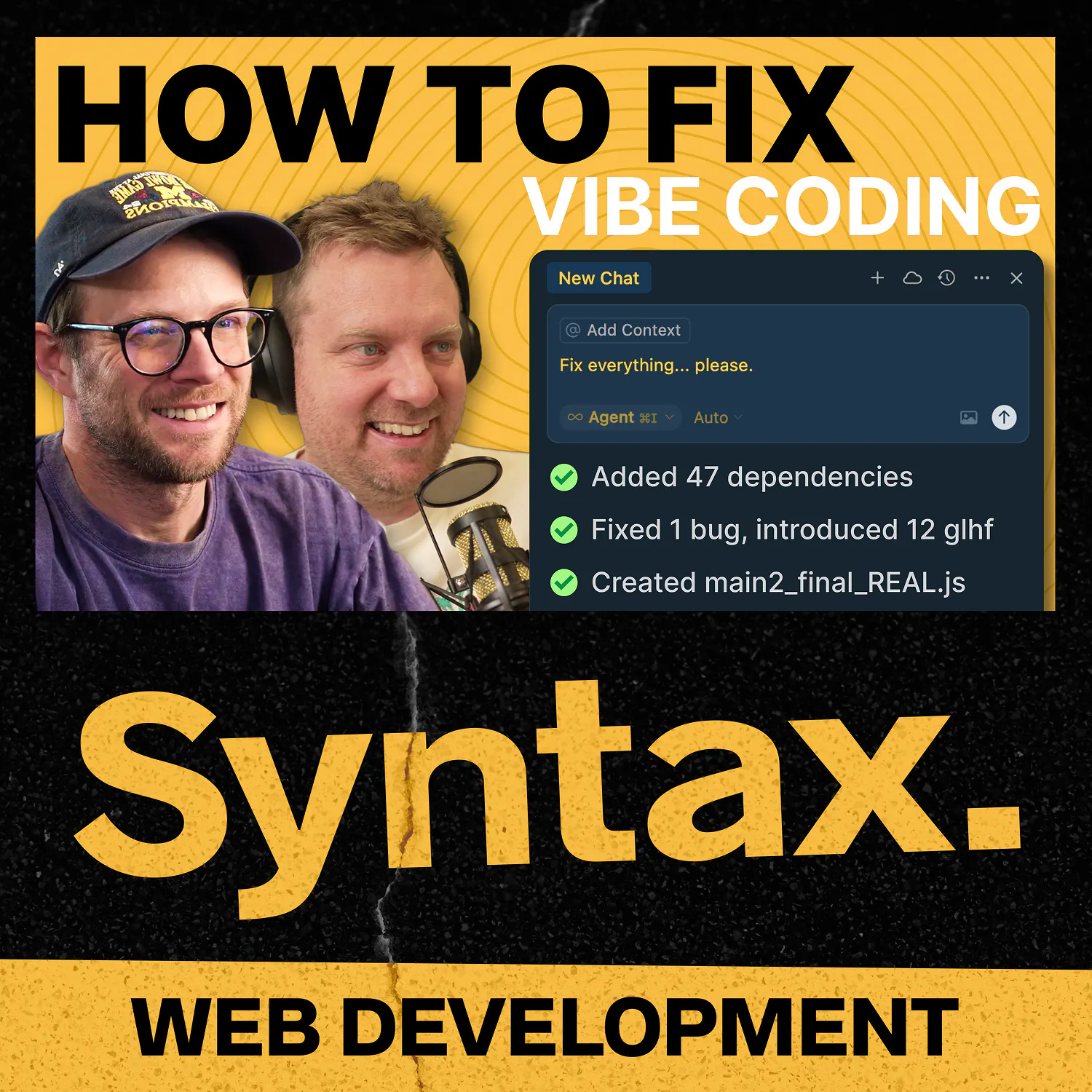
The podcast explores the risks of relying on AI-generated code without rigorous validation, emphasizing the unpredictability of AI outputs and their potential to create brittle systems or unresolved issues. It critiques the misconception that code quality and testing are irrelevant in AI-driven workflows, advocating for deterministic code practices and tools that enforce strict standards. Discussions focus on code analysis tools like JS.CPD and KNIP, which identify duplication and unused dependencies, as well as linters and formatters that enforce consistency. The episode highlights the importance of "enforceable guardrails," such as agent files and rule sets, to constrain AI-generated code and ensure adherence to predefined constraints. Tools like Fallow are recommended for detecting dead code, circular dependencies, and duplication across multiple languages, while self-improving systems and linting plugins are presented as methods to automate and enhance code quality.
The podcast also addresses challenges in AI-driven workflows, including over-specification of UI elements, potential over-complexity in utility functions, and the need for manual review over automated fixes. It emphasizes philosophical underpinnings, favoring functional programming and deterministic systems to counter AI-generated chaos, and underscores the value of transparency in code quality. Framework-specific tools, such as Sveltes auto-fixer, are discussed alongside calls for similar solutions in React or Vue. Infrastructure challenges, like the computational demands of headless browsers, are noted, with alternatives like Light Panda (a fast, CSS-skipping headless browser) and Cloudflares API being proposed. The importance of task management tools for deterministic workflows, alongside documentation systems like Context Seven, is highlighted to guide AI agents and ensure clarity in execution. Finally, the discussion touches on balancing control with flexibility in AI agent behavior, advocating for explicit skills, tools, and automated quality checks to maintain code integrity.