More The Pragmatic Engineer episodes

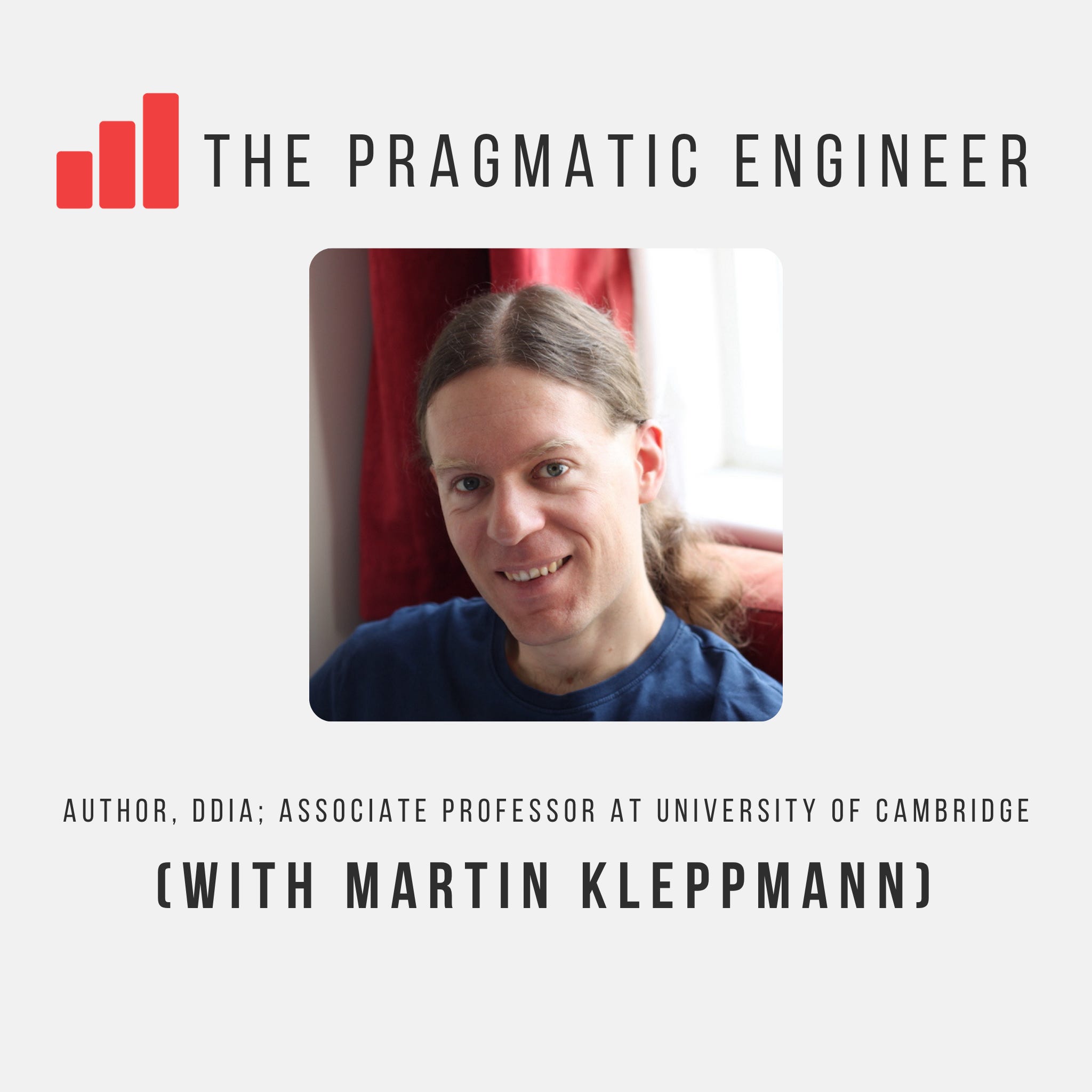
Designing Data-intensive Applications with Martin Kleppmann thumbnail

Designing Data-intensive Applications with Martin Kleppmann

Published 22 Apr 2026

Duration: 01:25:00

The second edition of *Designing Data-Intensive Applications* updates its focus to cloud-native systems, serverless architectures, and data lakes while addressing distributed system challenges, ethical engineering, decentralized software, and emerging trends like AI integration and cryptographic supply chain applications.

Episode Description

Brought to You By:Statsig The unified platform for flags, analytics, experiments, and more.Sonar The makers of SonarQube, the industry standard for au...

Overview

The podcast discusses the second edition of Designing Data-Intensive Applications, emphasizing its updated focus on modern data system design, including cloud-native architectures, serverless computing, data lakes, and AI-related systems like vector indexes. The author, Martin Klutman, reflects on his career transition from industry to academia, co-founding startups, and working on LinkedIns infrastructure, including Kafka. The books structure explores foundational principles of data systems, reliability, scalability, and maintainability, while addressing challenges like decentralized access, distributed processing, and ethical considerations in engineering. Klutman highlights the importance of understanding system internals for troubleshooting and decision-making, even when using managed services, and contrasts the trade-offs between abstraction and deep technical knowledge.

Key themes include the evolution from traditional to cloud-based architectures, the role of formal verification in ensuring system correctness, and the complexities of decentralized systems, such as access control and data synchronization. The second edition incorporates lessons from LinkedIns use of Kafka as a log-based system for data integration and expands into areas like local-first software and supply chain verification via cryptography. The podcast also touches on the tension between academic researchs focus on long-term, theoretical challenges and industrys pragmatic, short-term goals, while underscoring the need for engineers to weigh technical, societal, and financial trade-offs in system design.
Recent Episodes of The Pragmatic Engineer

27 May 2026 Building OpenCode with Dax Raad

OpenCode's rapid growth to 10 million users highlights challenges like feature overload and AI's limited impact on development speed, while underscoring tensions between innovation, product cohesion, sustainable practices, and the complexities of AI-driven workflows in software engineering.

20 May 2026 Why Rust is different, with Alice Ryhl

Rust prioritizes memory safety and performance via ownership, borrow checking, and `unsafe` blocks without garbage collection, balancing robust governance, community-driven tools like Cargo and Tokio, safety features including null safety and exhaustive pattern matching, and ongoing efforts to simplify learning curves and integrate AI-driven development, while standing out in system programming compared to TypeScript, JavaScript, and C++.

13 May 2026 TypeScript, C# and Turbo Pascal with Anders Hejlsberg

Anders Heilsberg's contributions to programming languages like Turbo Pascal, Delphi, C#, and TypeScriptshaping design philosophies, developer tools, and .NETalongside discussions on AI's impact on coding, type systems, and the evolution of language innovation.

29 Apr 2026 Building Pi, and what makes self-modifying software so fascinating

Pi, a minimalist self-modifiable AI coding agent for OpenClaw, examines engineering workflow challenges, ethical concerns, code quality issues, governance of non-expert contributions, and the evolving tension between AI-driven development, open-source ethics, and the enduring role of human expertise in software complexity.

8 Apr 2026 DHHs new way of writing code

David Heinemeier Hansson shifts from critiquing AI coding tools to embracing an AI-first approach at 37signals, emphasizing Ruby on Rails' token efficiency, Omachi's user-friendly design, AI-driven productivity, evolving developer roles, and the balance between automation and craftsmanship in software innovation.

More The Pragmatic Engineer episodes