17 Sept 2026 AI Skills with Matt Pocock
"Former voice coach turned developer shares insights on AI integration in software engineering, emphasizing fundamentals, adaptability, and structured workflows for productivity."
More The Pragmatic Engineer episodes
Published 8 Apr 2026
Duration: 01:46:14
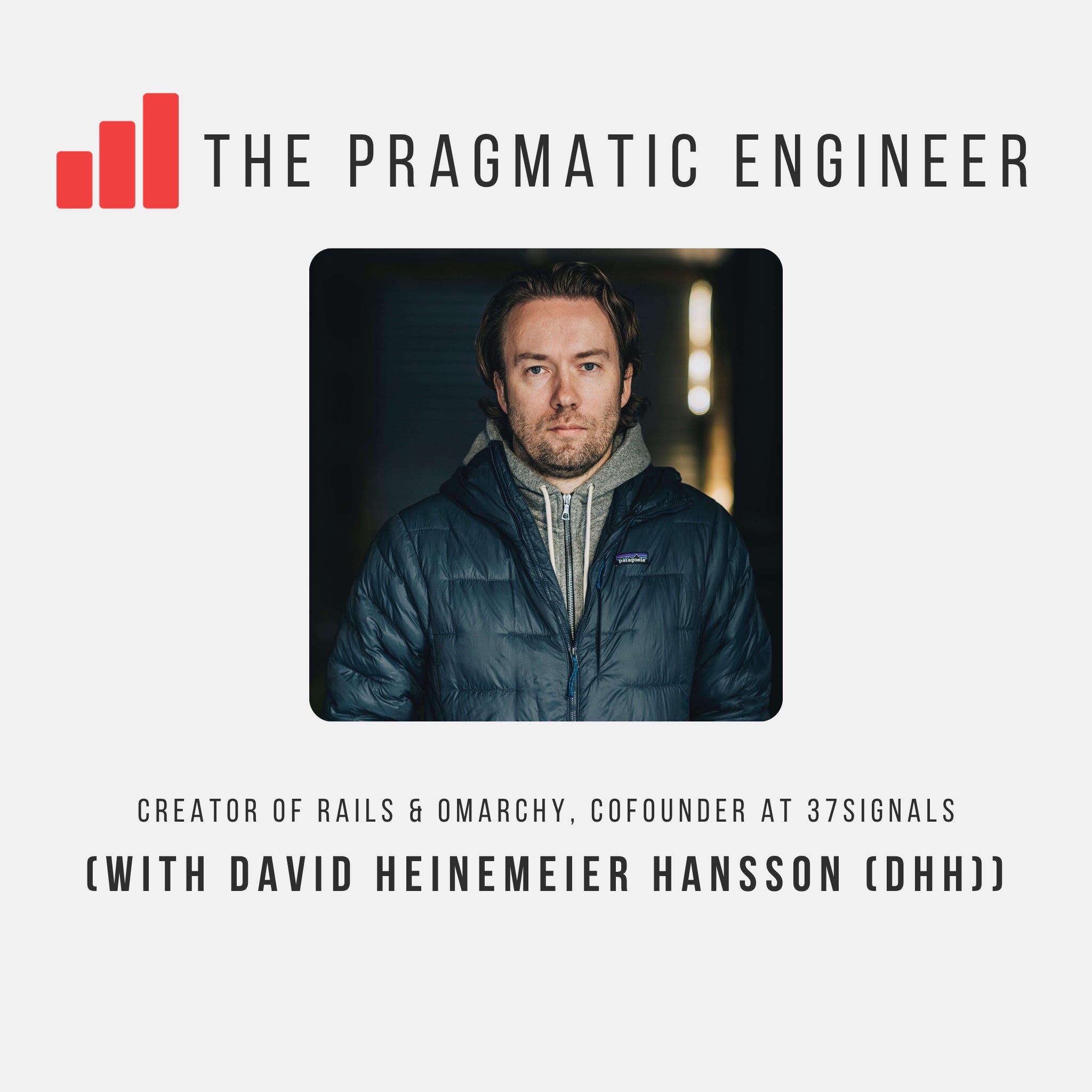
David Heinemeier Hansson shifts from critiquing AI coding tools to embracing an AI-first approach at 37signals, emphasizing Ruby on Rails' token efficiency, Omachi's user-friendly design, AI-driven productivity, evolving developer roles, and the balance between automation and craftsmanship in software innovation.
Brought to You By:Statsig The unified platform for flags, analytics, experiments, and more.Sonar The makers of SonarQube, the industry standard for au...
The podcast explores David Heinemeier Hanssons (DHH) journey from initial skepticism to embracing AI tools, leveraging AI agents to enhance software development at 37signals. Ruby on Rails remains relevant due to its efficiency in AI workflows, while his Linux distribution, Omachi, showcases a shift toward simplifying user experiences. 37signals has transitioned to prioritizing Omachi as the default development environment, reflecting broader industry trends toward centralized adoption of tools that align with AI advancements. The discussion also highlights software craftsmanship, emphasizing the enduring value of skilled engineers and designers who prioritize aesthetics and functionality, alongside advocacy for Linuxs role in developer workflows due to its proximity to production systems.
A significant focus is placed on the development of Hey.com, an email service designed to restore emails value by empowering users to curate their inboxes through a manual "screener" system. The products success underscores a philosophy of user-centric design and long-term product development, contrasting with modern email platforms. The episode delves into product development methodologies, advocating small, iterative teams and the integration of designers in both implementation and ideation, while critiquing the industrys tendency toward siloed roles. Challenges in hiring multifaceted talentthose who can balance design, product strategy, and codeare also addressed, alongside evolving roles for programmers in an AI-driven era.
The podcast further examines AIs maturation from early limitations (e.g., autocompletion frustrations) to its current potential, particularly with advanced models like Opus 4.5, which enable agent-first workflows. It stresses the importance of maintaining code quality and aesthetic standards in AI-generated outputs, while noting the growing productivity gains for developers using AI tools. Industry-wide shifts are discussed, including the need for human oversight in AI systems, the tension between innovation and ethical considerations, and the redefinition of roles in software engineering. Themes of health, purpose, and curiosity are interwoven, emphasizing that long-term fulfillment in tech requires balancing productivity with well-being and a commitment to craftsmanship.
17 Sept 2026 AI Skills with Matt Pocock
"Former voice coach turned developer shares insights on AI integration in software engineering, emphasizing fundamentals, adaptability, and structured workflows for productivity."
9 Sept 2026 Building Codex with Tibo Sottiaux
"Explores Codex's AI-powered coding assistant development, Rust's role, open-source benefits, AI's impact on software workflows, and the future of AI-assisted problem-solving."
26 Aug 2026 Why performant code matters (but gets widely ignored), with Casey Muratori
"Performance optimization in software hinges on early architectural decisions, deep system knowledge, and avoiding premature abstraction, with historical and modern challenges shaping its evolution."
19 Aug 2026 From Chrome DevTools to AI Engineering, with Addy Osmani
"AI is reshaping software engineering by automating coding tasks, while adaptability, leadership, and lifelong learning remain key to thriving in the evolving tech landscape."
12 Aug 2026 Stop being skeptical about AI for development with Charity Majors
"AI's impact on software engineering is reshaping code review, reliability, and career paths, demanding new verification methods, ethical accountability, and adaptability in a rapidly evolving field."