Shopify's AI strategies involve in-house tools like Tangled and QMD to automate workflows, collaborate with the AI community, address challenges in token usage and code quality, and explore applications in e-commerce, CI/CD optimization, and scalable AI experimentation.

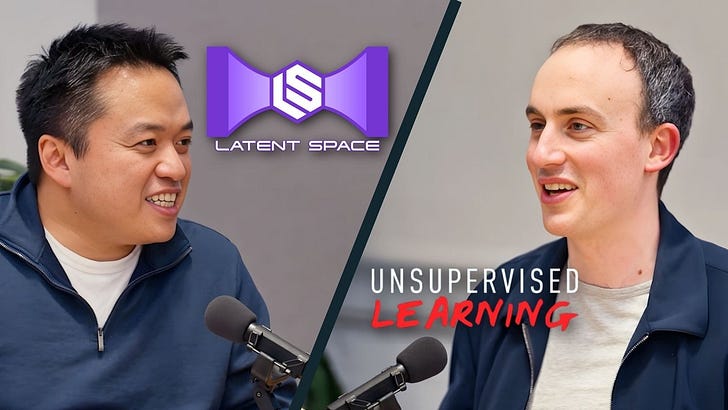
AIE Europe Debrief + Agent Labs Thesis: Unsupervised Learning x Latent Space Crossover Special (2026)
Published 23 Apr 2026
Duration: 00:54:52
The text discusses AI's evolving landscape, focusing on experimental agents potentially breaking containment by 2026, market disruptions from foundation models, infrastructure advancements like RAG, debates between infrastructure and application firms, outsourcing strategies, pre-2023 training data advantages, competitive coding AI sectors, and future trends in personalization and industry transformation amid scalability and quality challenges.
Episode Description
Today, we check in a year after the first Unsupervised Learning x Latent Space Crossover specialto discuss everything that has changed (there is a lot...
Overview
The podcast explores the current phase of AI development, emphasizing capability exploration and experimentation with AI agents, with speculation that by 2026, these agents may transcend their current constraints to handle broader tasks. Discussions highlight tensions in the AI ecosystem, including concerns over foundation models disrupting mid-sized startups and the potential for structural market shifts. Infrastructure evolution is a key focus, with challenges in adapting to rapid advancements in large language models (LLMs), retrieval systems, and file-system integration, as well as the rise of custom hardware like Cerebris and Talos. Infrastructure firms face pressure to innovate, while application companies may benefit from aligning with model improvements. The debate between vertical (infrastructure) and horizontal (application) strategies underscores the difficulty of balancing frequent reinvention against practical scalability.
The podcast also addresses trends like agent engineering, Retrieval-Augmented Generation (RAG), and multi-modality, alongside enduring challenges in evaluations, observability, and GPU usage. Outsourcing AI functions, exemplified by Legora as a "translation layer" for businesses, is highlighted as a strategic choice over in-house development, driven by the need to adapt to evolving technologies. However, the trade-offs between in-house models (for cost, latency, and branding) and reliance on external labs for domain-specific needs remain contentious. Future directions include shifts toward personalization, adaptive memory systems, and the integration of AI into industries beyond coding, with healthcare and finance identified as potential expansion areas. Despite rapid growth in the AI coding market, uncertainty persists about long-term market structures, with predictions of a duopoly or niche providers catering to underserved use cases. Emerging challenges include scalability limitations, context-length barriers, and the need for better evaluation frameworks, as well as philosophical questions about AIs ability to achieve embodied understanding beyond token prediction.
Recent Episodes of Latent Space
CLIs and MCPs are emphasized for enterprise efficiency, alongside challenges in early AI integration, custom agent development for automation, strategic AGI management, and balancing automation with oversight, pricing, and collaboration tools like Notion.
AI integration in product development, such as Codex, automates coding tasks, reduces manual effort, and enables zero-code tools, while addressing challenges like adapting build systems, balancing automation with human oversight, systems thinking for observability, agent autonomy in code review, and maintaining human control in enterprise settings.
AI's ongoing advancements, rooted in decades of progress from neural networks to transformers, highlight a long-term trend with transformative potential, yet face integration challenges, societal fragmentation, and the need to balance optimism with caution amid historical tech cycle parallels and systemic inertia.
The text addresses challenges in AI benchmarking for complex tasks like personalized recommendations, critiques current models' limitations in nuanced interaction and symbolic understanding, and advocates for multimodal, interactive AI with embodied reasoning, simulation theory, and hybrid frameworks to balance symbolic abstraction and efficiency, addressing gaps in vision-language and generative video models.