AI integration in product development, such as Codex, automates coding tasks, reduces manual effort, and enables zero-code tools, while addressing challenges like adapting build systems, balancing automation with human oversight, systems thinking for observability, agent autonomy in code review, and maintaining human control in enterprise settings.

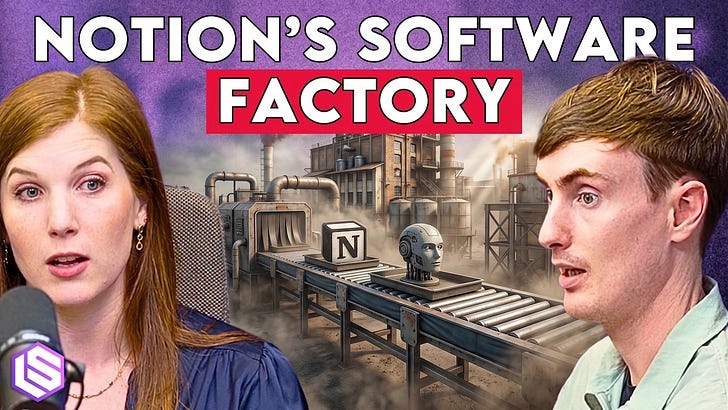
Notions Token Town: 5 Rebuilds, 100+ Tools, MCP vs CLIs and the Software Factory Future Simon Last & Sarah Sachs of Notion
Published 15 Apr 2026
Duration: 01:25:37
CLIs and MCPs are emphasized for enterprise efficiency, alongside challenges in early AI integration, custom agent development for automation, strategic AGI management, and balancing automation with oversight, pricing, and collaboration tools like Notion.
Episode Description
For all those who missed out on London, see you in Miami next week!Notion, the knowledge work decacorn, has been building AI tooling since before Chat...
Overview
The podcast discusses technical strategies and development challenges related to command-line interfaces (CLIs) and Machine Communication Protocols (MCPs). The speaker emphasizes CLIs for their efficiency and reliability, while MCPs are positioned as lightweight, secure frameworks for enterprise workflows, offering controlled tool calls and simplicity. Custom agents, developed after extensive refinement, focus on reliability and granular access controls, with their launch marked as a major success due to high user engagement. Early AI tool development faced hurdles like limited function calling and context windows, but advancements in models and tooling enabled progress. Strategic considerations include balancing expectations around artificial general intelligence (AGI) with practical product roadmaps, prioritizing user education, and iterating based on feedback.
Notions differentiation as a horizontal SaaS platform is highlighted, contrasting its focus on collaboration with vertical SaaS solutions. The discussion centers on user-centered design principles, such as decomposing needs into reusable primitives and avoiding feature-driven development. Internal workflows emphasize prototyping, hackathons, and a culture of rapid iteration and adaptability. Security and compliance are prioritized early in development, while agents are being integrated into workflows for automation, including meeting notes, email triaging, and task management. Challenges include managing agent recursion, ensuring robust memory systems, and aligning tool access with user needs.
The content also addresses the evolution of AI agents toward self-sufficient systems, with a focus on coding agents enabling self-debugging and maintenance. Evaluation frameworks and model behavior engineering are critical for quality assurance, with a push to redefine software engineering roles as agents automate coding tasks. The podcast explores balancing innovation (e.g., experimental "crazy" projects) with practicality, while prioritizing scalable, user-driven solutions. Future directions include enhancing agent autonomy, refining evaluation benchmarks, and expanding agent capabilities to handle complex workflows without over-reliance on high-cost models.
Recent Episodes of Latent Space
AI's ongoing advancements, rooted in decades of progress from neural networks to transformers, highlight a long-term trend with transformative potential, yet face integration challenges, societal fragmentation, and the need to balance optimism with caution amid historical tech cycle parallels and systemic inertia.
The text addresses challenges in AI benchmarking for complex tasks like personalized recommendations, critiques current models' limitations in nuanced interaction and symbolic understanding, and advocates for multimodal, interactive AI with embodied reasoning, simulation theory, and hybrid frameworks to balance symbolic abstraction and efficiency, addressing gaps in vision-language and generative video models.
30 Mar 2026 Mistral: Voxtral TTS, Forge, Leanstral, & what's next for Mistral 4 w/ Pavan Kumar Reddy & Guillaume Lample
Mistral's Voxtral TTS is a 3B-parameter text-to-speech model leveraging neural audio codecs, semantic/acoustic token splitting, and efficient flow matching for multilingual real-time applications, balancing quality and cost while exploring future refinements in architecture, tokenization, and domain-specific training.
24 Mar 2026 Why There Is No "AlphaFold for Materials" AI for Materials Discovery with Heather Kulik
AI's role in education and materials science is debated, highlighting its potential to accelerate research in chemistry and physics through machine learning, yet acknowledging limitations in complex molecular design, data quality challenges, and the need for interdisciplinary collaboration and robust validation.