More Latent Space episodes

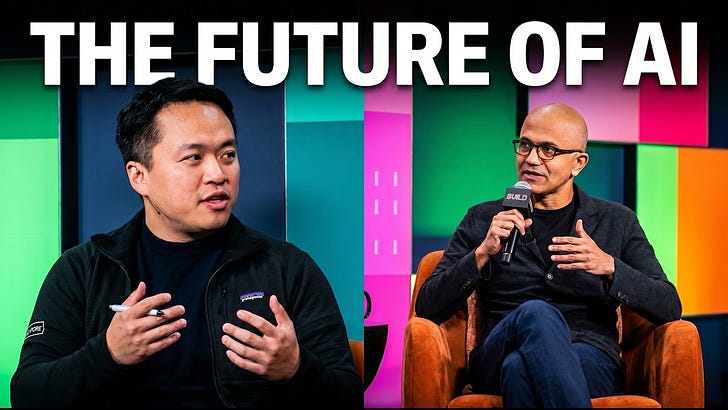
Satya Nadella: No Priors x Latent Space Crossover Special at Microsoft Build thumbnail

Satya Nadella: No Priors x Latent Space Crossover Special at Microsoft Build

Published 3 Jun 2026

Duration: 00:38:57

Strategic AI development shifts to ecosystem-driven frameworks prioritizing value creation, covering Microsoft's rigorous model training, agent-driven workflow management, real-world impact challenges, innovative business models, inclusive AI participation, and redefining work through agentic systems.

Episode Description

Weve informally heard that Satya is a listener to LS for a couple years now, but it was still absolutely surreal to meet him and do a live pod at Buil...

Overview

The discussion centers on strategies for leveraging AI across ecosystems, contrasting single-platform approaches with the need for interconnected systems that generate value for all participants. Emphasis is placed on building "clean lineage" for AI models through rigorous pre-training and evaluation, enabling organizationsboth AI-native and traditionalto act as "first-class participants" in AI development. The frontier of AI involves pushing boundaries with smaller, refined models and real-world performance metrics, while addressing gaps between benchmark success and tangible user value. Training strategies highlight the importance of private evaluations and "hill climbing scaffolds" to iteratively improve models, alongside tools like GitHubs harness for integrating models, data, and tools in scalable workflows. Agent-driven systems are explored as solutions to complex coding and operational tasks, requiring new UIs (like ADE) to manage cognitive load and enable durable, autonomous agents that augment human "glue work" while maintaining accountability through verification processes.

Key themes include redefining SaaS models to accommodate agentic workflows, balancing per-user and consumption-based pricing, and the rise of agent-specific solutions over generic software. The role of infrastructure and context layers in enabling efficient task execution is stressed, alongside the need for open harness platforms and model interoperability to support flexible, real-world applications. The text also addresses challenges in aligning human expertise with AI-driven systems, suggesting future accounting standards may recognize agent expertise as a valuable asset. Societal considerations include ensuring inclusive participation in AIs economic benefits, tangible community-level impacts from infrastructure projects like data centers, and the imperative of education and training to support equitable growth. The broader vision extends to reimagining work through autonomous agents, fostering innovation in healthcare, entrepreneurship, and operational efficiency, while cautioning against overreliance on vague promises and emphasizing measurable outcomes to build public trust.
What If

  • What if you built a private evaluation framework to validate your AI models against real-world customer workflows?

    • Move: Integrate a private evaluation loop into your model iteration process, using anonymized customer data traces (e.g., from GitHub repos or app logs) to measure performance on specific tasks like code generation or document analysis.
    • Why Now? Current benchmarks (e.g., MMLU) are insufficient for measuring practical value; private evals allow you to align model improvements with customer needs while avoiding data leakage.
    • Expected Upside: Faster model refinement, higher customer adoption, and a defensible IP asset (e.g., eval metrics) that differentiates your offering in competitive markets.
  • What if you rearchitected your SaaS platform to prioritize agentic workflows over traditional front-end UIs?

    • Move: Shift from generic UIs to a canvas-based "Agent Development Environment" (ADE) that lets users visually design and monitor long-running agents (e.g., a "code chief of staff" autopilot).
    • Why Now? Users increasingly face cognitive overload with fragmented agent interactions; ADEs (like GitHubs harness) are critical for managing complex, multi-step tasks at scale.
    • Expected Upside: Higher user retention through streamlined workflows, reduced maintenance costs via durable agents, and the ability to capture new revenue streams (e.g., agent-as-a-service tiers).
  • What if you positioned your startup as a "first-class participant" in the AI ecosystem by collaborating with open-source models and tools?

    • Move: Develop a flexible harness that interoperates with multiple models (e.g., Llama, Meta), enabling your product to stay agnostic while allowing customers to train specialists on their own data.
    • Why Now? Major players (e.g., Microsoft) are open-sourcing foundational tools (e.g., GitHubs harness) to accelerate ecosystem growth; aligning with this trend reduces your dependency on single platforms.
    • Expected Upside: Faster time-to-market for verticalized applications, increased community adoption, and the ability to charge for proprietary extensions (e.g., custom tools, context layers) built on open ecosystems.

Takeaway

  • Build an ecosystem-driven platform by creating APIs or tools that enable third-party integration, allowing others to extend your softwares capabilities and generate compounding value through shared innovation.
  • Prioritize high-quality training data and iterative refinement for your AI models, using private evaluations to measure real-world performance and avoid over-reliance on standardized benchmarks.
  • Leverage agent workflows with a canvas-based interface to manage complex tasks, replacing "chat as the only artifact" with visual workflows that enhance productivity and reduce cognitive load for users.
  • Design flexible AI systems with open harness compatibility to support multiple models, tools, and contexts, ensuring interoperability and adaptability for evolving use cases and customer needs.
  • Adopt a consumption-based pricing model for agent-driven features, metering usage instead of charging per user to align with the scalability of autonomous systems and avoid conflicts with enterprise adoption.

Recent Episodes of Latent Space

3 Jun 2026 Scaling Past Informal AI - Carina Hong, Axiom Math

Formal verification is positioned as a critical tool for advancing AI by ensuring system correctness through mathematical rigor, exemplified by Axiom Math's achievements, tools like Lean, challenges in AI generalization, and the vision of AI as a "superhuman mathematician" through verified reasoning.

2 Jun 2026 GitHub's plan for Agents Kyle Daigle, GitHub

Advanced AI integration in developer workflows leverages tools like GitHub Copilot and agentic systems to automate tasks and boost productivity, while addressing challenges like skill bloat, security, open-source trust issues, and the shift to modular AI capabilities in enterprise and collaborative environments.

1 Jun 2026 Why Video Agent models are next Ethan He, xAI Grok Imagine

Advancements in AI research through community-driven knowledge sharing, challenges in scaling video models, technical innovations like vision transformers and diffusion models, and the integration of language models in generative media, alongside hurdles in training efficiency and sustainable development.

28 May 2026 The Age of Async Agents Cognition's Walden Yan & OpenInspect's Cole Murray

The evolution of AI agent development shifts toward autonomous workflows via tools like Devin for code generation and OpenInspect for cloud management, addressing growth, infrastructure challenges, security, scalability, enterprise adoption, open-source initiatives, diverse non-engineering use cases, and the role of human oversight in AI-native coding.

27 May 2026 ESMFold2: The Bitter Lesson is Coming for Proteins - Alex Rives, BioHub

ESMC leverages transformer-based models trained on 6.8 billion protein sequences to predict structures, design functional proteins, and uncover evolutionary patterns through scalable, data-driven approaches, while balancing evolutionary constraints with interpretability and addressing limitations in data diversity and model generalizability.

More Latent Space episodes