17 Sept 2026 AI Skills with Matt Pocock
"Former voice coach turned developer shares insights on AI integration in software engineering, emphasizing fundamentals, adaptability, and structured workflows for productivity."
More The Pragmatic Engineer episodes
Published 29 Jul 2026
Duration: 01:23:42
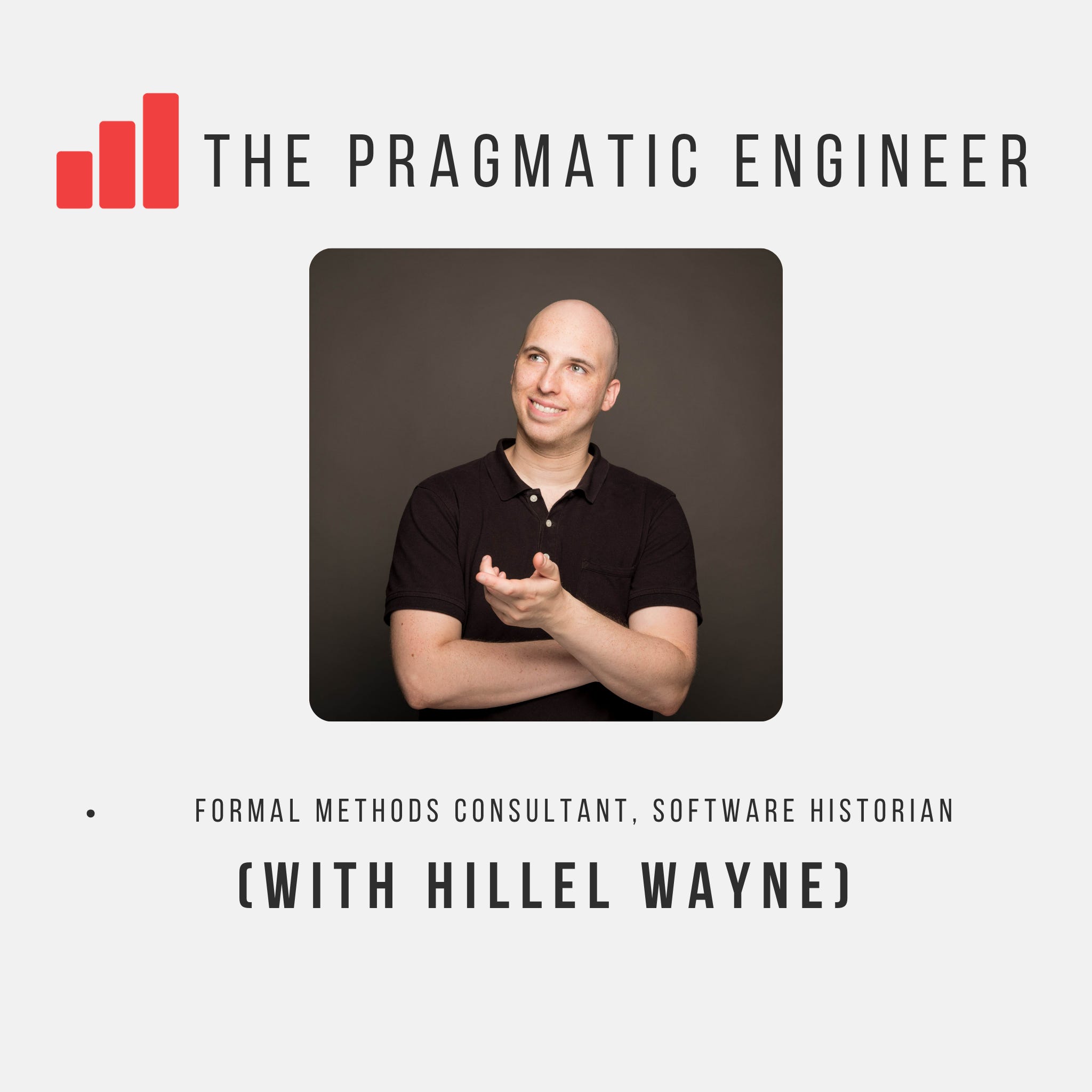
"Formal verification methods, like TLA+ in AWS's DynamoDB, ensure AI-generated code correctness, with property-based testing offering a practical middle ground; the discussion affirms software engineering as a legitimate discipline, balancing traditional principles with rapid iteration and open-source culture, while exploring AI's future impact on development and job markets."
Brought to You By:* Antithesis - verify your system's correctness without human review or traditional integration tests - and avoid bugs or outages.*...
The podcast discusses the application of formal methods in software engineering, particularly in verifying the correctness of AI-generated code and distributed systems. Tools like TLA+ and Alloy are highlighted for their ability to model system behavior, uncover race conditions, and detect complex bugs - such as TOCTOU (time-of-check to time-of-use) errors - through exhaustive state exploration. Real-world examples include Amazon's use of TLA+ to find critical bugs in DynamoDB and S3, demonstrating how formal verification can catch issues that are impractical for humans to identify manually due to the vast number of possible state transitions.
The discussion also explores the distinction between software and traditional engineering disciplines, with findings suggesting software engineering aligns more closely with established engineering practices than commonly assumed. Lightweight formal methods, property-based testing, and deterministic simulation testing are presented as practical middle grounds between full formal verification and conventional testing. The podcast further examines how AI impacts software development, noting its potential to assist in specification and verification - but emphasizing that human expertise remains essential, especially in defining system properties and interpreting results. Additionally, topics like version control, open-source culture, and the democratization of software development through AI and low-code tools are discussed as unique characteristics shaping the field's evolution.
What if you applied lightweight formal methods to your core AI-generated code today?
What if you modeled your system's key state transitions like a distributed engineer - even if you're solo?
What if you treated version control not just as backup - but as engineering leverage?
17 Sept 2026 AI Skills with Matt Pocock
"Former voice coach turned developer shares insights on AI integration in software engineering, emphasizing fundamentals, adaptability, and structured workflows for productivity."
9 Sept 2026 Building Codex with Tibo Sottiaux
"Explores Codex's AI-powered coding assistant development, Rust's role, open-source benefits, AI's impact on software workflows, and the future of AI-assisted problem-solving."
26 Aug 2026 Why performant code matters (but gets widely ignored), with Casey Muratori
"Performance optimization in software hinges on early architectural decisions, deep system knowledge, and avoiding premature abstraction, with historical and modern challenges shaping its evolution."
19 Aug 2026 From Chrome DevTools to AI Engineering, with Addy Osmani
"AI is reshaping software engineering by automating coding tasks, while adaptability, leadership, and lifelong learning remain key to thriving in the evolving tech landscape."
12 Aug 2026 Stop being skeptical about AI for development with Charity Majors
"AI's impact on software engineering is reshaping code review, reliability, and career paths, demanding new verification methods, ethical accountability, and adaptability in a rapidly evolving field."