17 Sept 2026 AI Skills with Matt Pocock
"Former voice coach turned developer shares insights on AI integration in software engineering, emphasizing fundamentals, adaptability, and structured workflows for productivity."
More The Pragmatic Engineer episodes
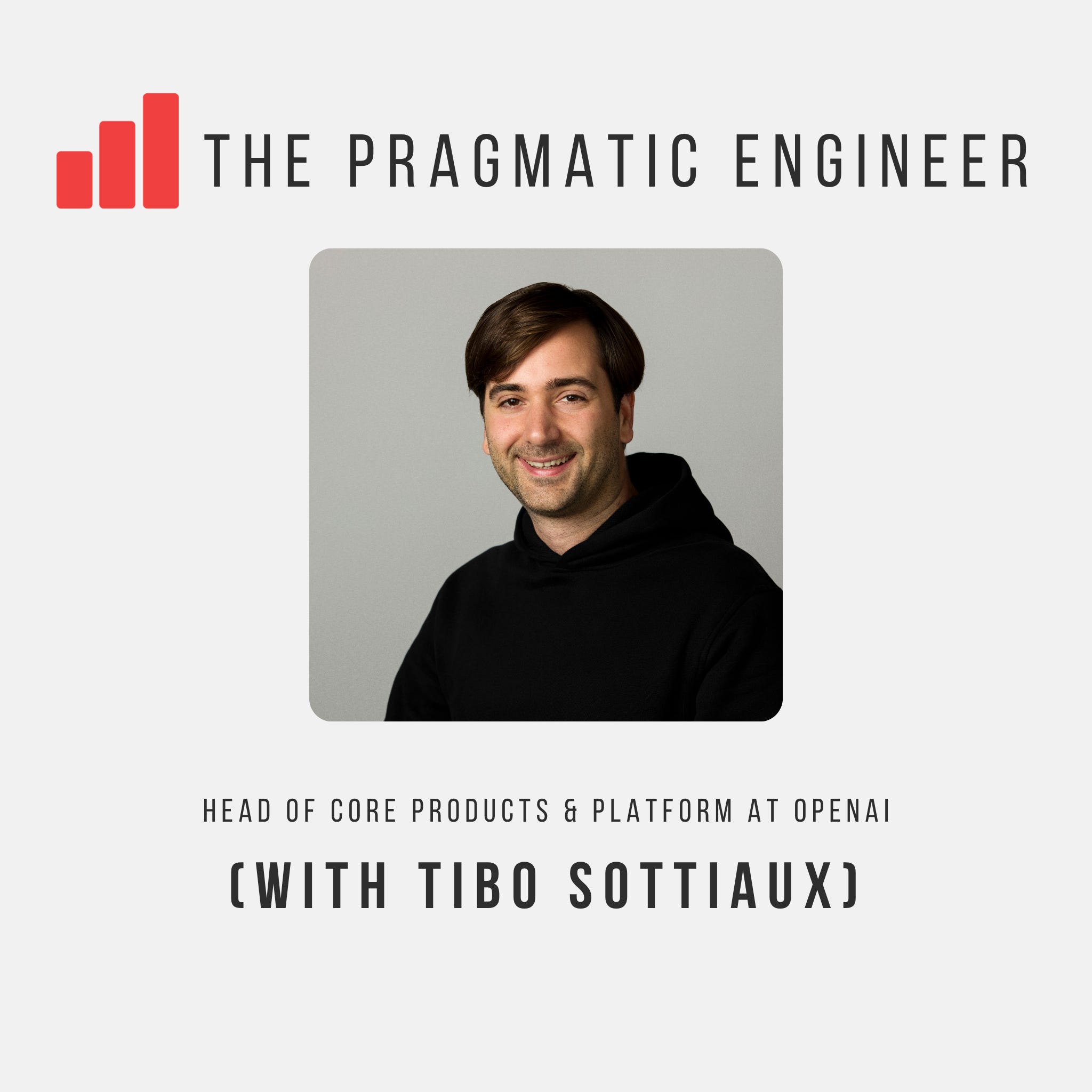
Published 9 Sept 2026
Duration: 01:13:21
"Explores Codex's AI-powered coding assistant development, Rust's role, open-source benefits, AI's impact on software workflows, and the future of AI-assisted problem-solving."
Brought to You By:* turbopuffer - a vector and full-text search engine built on object storage. It's fast, cheap, and extremely scalable* Antithesis -...
The podcast discusses the development and integration of Codex into ChatGPT, highlighting the technical challenges of merging two distinct systems - one local and one cloud-based - while ensuring scalability for hundreds of millions of users. The engineering team chose Rust for Codex's core due to its performance, security, and long-term scalability, prioritizing robustness over development speed. A key design principle was maintaining a clear separation between the agent's core logic and the product interface to support future innovation.
The conversation explores the evolution of AI-assisted software development, including the shift from manual coding to using AI agents for tasks like refactoring, testing, and long-running problem solving. Tools like Codex now enable engineers to set high-level goals and delegate execution, with newer models increasingly capable of handling extended tasks without external guidance. The integration of Codex into ChatGPT has created a unified, permissive environment where users can perform complex operations such as training models or installing software, supported by a harness that provides guardrails and improves reliability.
OpenAI's culture emphasizes small, empowered teams, rapid iteration, and deep alignment between research and product development. The team focuses on building tools that enhance efficiency and scalability, using automation to handle correctness, security, and maintenance. As AI models improve, the role of human engineers is shifting toward defining system invariants, architecture, and intent, while AI handles low-level implementation. The long-term vision includes a proactive, deeply personalized AI that operates seamlessly across devices and workflows, minimizing configuration and maximizing utility.
What if you rebuilt your core tool in a more robust language now?
What if you open-sourced your agent's harness to accelerate real-world testing and community innovation?
What if you shifted from manual code reviews to AI-powered validation with human oversight for architecture only?
17 Sept 2026 AI Skills with Matt Pocock
"Former voice coach turned developer shares insights on AI integration in software engineering, emphasizing fundamentals, adaptability, and structured workflows for productivity."
26 Aug 2026 Why performant code matters (but gets widely ignored), with Casey Muratori
"Performance optimization in software hinges on early architectural decisions, deep system knowledge, and avoiding premature abstraction, with historical and modern challenges shaping its evolution."
19 Aug 2026 From Chrome DevTools to AI Engineering, with Addy Osmani
"AI is reshaping software engineering by automating coding tasks, while adaptability, leadership, and lifelong learning remain key to thriving in the evolving tech landscape."
12 Aug 2026 Stop being skeptical about AI for development with Charity Majors
"AI's impact on software engineering is reshaping code review, reliability, and career paths, demanding new verification methods, ethical accountability, and adaptability in a rapidly evolving field."
29 Jul 2026 Formal methods with Hillel Wayne
"Formal verification methods, like TLA+ in AWS's DynamoDB, ensure AI-generated code correctness, with property-based testing offering a practical middle ground; the discussion affirms software engineering as a legitimate discipline, balancing traditional principles with rapid iteration and open-source culture, while exploring AI's future impact on development and job markets."