12 Nov 2026 If I Wanted to 10x My Revenue in 2027, Id Do This | Matt Trinetti | 154
Scaling a membership business from $500,000 to $5 million requires mastering mission, funnel metrics, retention strategies, product clarity, and LTV to CAC ratios.
More The Nathan Barry Show episodes
Published 26 Nov 2026
Duration: 01:23:26
A book launch leveraging existing relationships raised nearly $300,000 on Kickstarter, utilizing section-based beta reading and bulk order distribution to prioritize reader engagement over cold traffic.
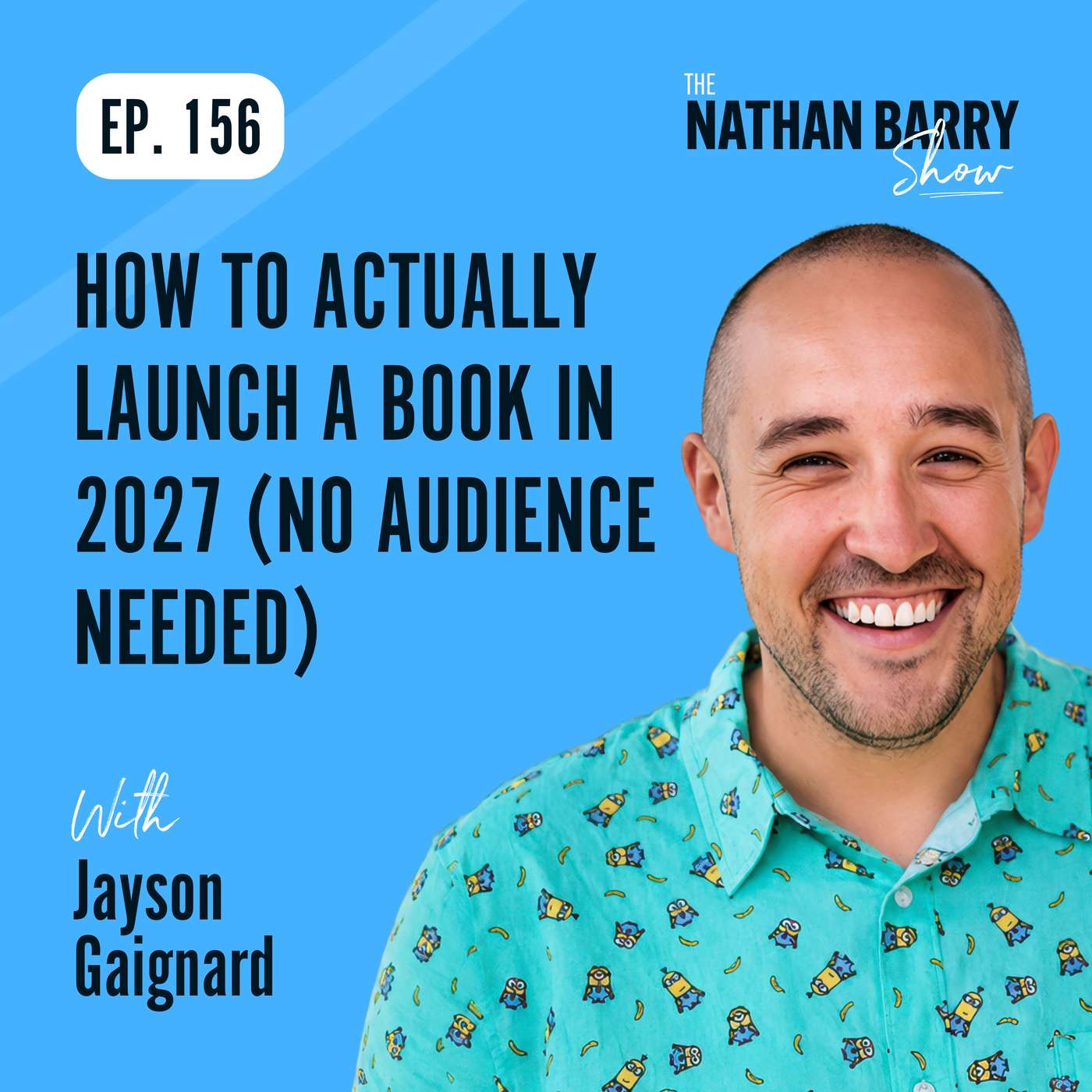
How do you launch a book and sell thousands of copies without a huge audience?Jayson Gaignard pre-sold 21,000 copies of his new book, Community Made,...
The podcast centers on an unconventional book launch strategy in which the guest pre-sold 21,000 copies of his new book with only 2,000 Instagram followers. He used Kickstarter as a dual-launch mechanism, hitting a $50,000 goal within 14 minutes and doubling it within the first 24 hours, ultimately closing near $294,000 in Canadian funds. The Kickstarter ran from April to June, roughly two-thirds of the way before the public launch in late September. A key strategic choice was prioritizing reader relationships over volume: he stated he would rather sell a thousand copies on Kickstarter than five or even 10,000 on Amazon, because building a relationship with the reader was critical.
Several distinctive tactics drove the campaign. A beta-reading process used a section-based approach rather than distributing the full manuscript, yielding 102 completers whose testimonials were captured at peak enthusiasm. Bulk orders were made frictionless through a Shopify site with distinct codes, letting buyers who purchased 50, 100, or 150 copies share claim links so recipients could get the book free with shipping paid. In-person gatherings of roughly 60 invited friends concluded with a brainstorm exercise that produced around 110 written submissions of distribution ideas and connections.
Strategic positioning drew on mining two-to-four-star Amazon reviews of competing titles through AI to identify gaps, and on a gradual-engagement model that captured supporter intent via a simple form early in the process. The guest also emphasized a 30-day email integration challenge as a post-launch flywheel, designed to drive reviews and gifting over time rather than relying on a single launch-day push.
What if you ran a time-boxed pre-sale window for your next product or tool release?
What if you mined two-to-four-star reviews of competing tools to shape your product positioning before you write a single line of copy?
What if you captured supporter intent through a one-field form months before your launch, then followed up with a personalized ask?
Build a Shopify (or equivalent) code-redemption page so bulk buyers who purchase 50, 100, or 150 units can share claim links with their own audience, with you covering shipping. This removes the "what do I do with all these books" objection that stalls bulk commitments.
Run a two-to-three-hour AI-assisted mining pass on the two-to-four-star reviews of your top three competitors. Extract recurring praise, complaints, and gaps, then rewrite your onboarding copy, feature roadmap, and FAQ to pre-empt those objections before launch.
Set up a 30-day email sequence triggered by an in-product opt-in (e.g., "Join the 30-day integration challenge"). Schedule a review ask around day 18 and a gift-a-copy prompt around day 26, so each reader becomes a potential reviewer and referrer without a single manual follow-up.
Place a one-field intent-capture form (name, email, how they want to help) on every progress post you publish in the months before launch. When the launch window opens, forward each person's own submission back with a specific, small ask; the source reports roughly 90% follow-through on pledges captured this way.
Draft endorsements for your endorsers rather than asking them to write one. Spend three to four hours per endorsement, pulling from the endorser's own transcripts and public voice, and tailor each to a distinct angle (method, results, credibility). The guest's three initial endorsers all said yes to this approach.
12 Nov 2026 If I Wanted to 10x My Revenue in 2027, Id Do This | Matt Trinetti | 154
Scaling a membership business from $500,000 to $5 million requires mastering mission, funnel metrics, retention strategies, product clarity, and LTV to CAC ratios.
5 Nov 2026 How to Grow and Monetize a Newsletter in 2027 (Full Strategy) | Chenell Basilio | 153
Five key levers for newsletter growth include valuable content, clear positioning, focused distribution, optimized conversion, and enhanced subscriber experience.
22 Oct 2026 Why Community Beats Followers (And How to Build One) | Jayson Gaignard | 151
The podcast explores strategies for building networks and communities, emphasizing the importance of genuine connections and challenging the notion of self-made success.
15 Oct 2026 AI Can't Copy This: Why Every Creator Needs an Origin Story in 2026 | Philip McKernan | 150
Sharing personal stories, especially origin stories, can help connect authentically and find purpose, with one's greatest gift often lying next to their deepest wound.