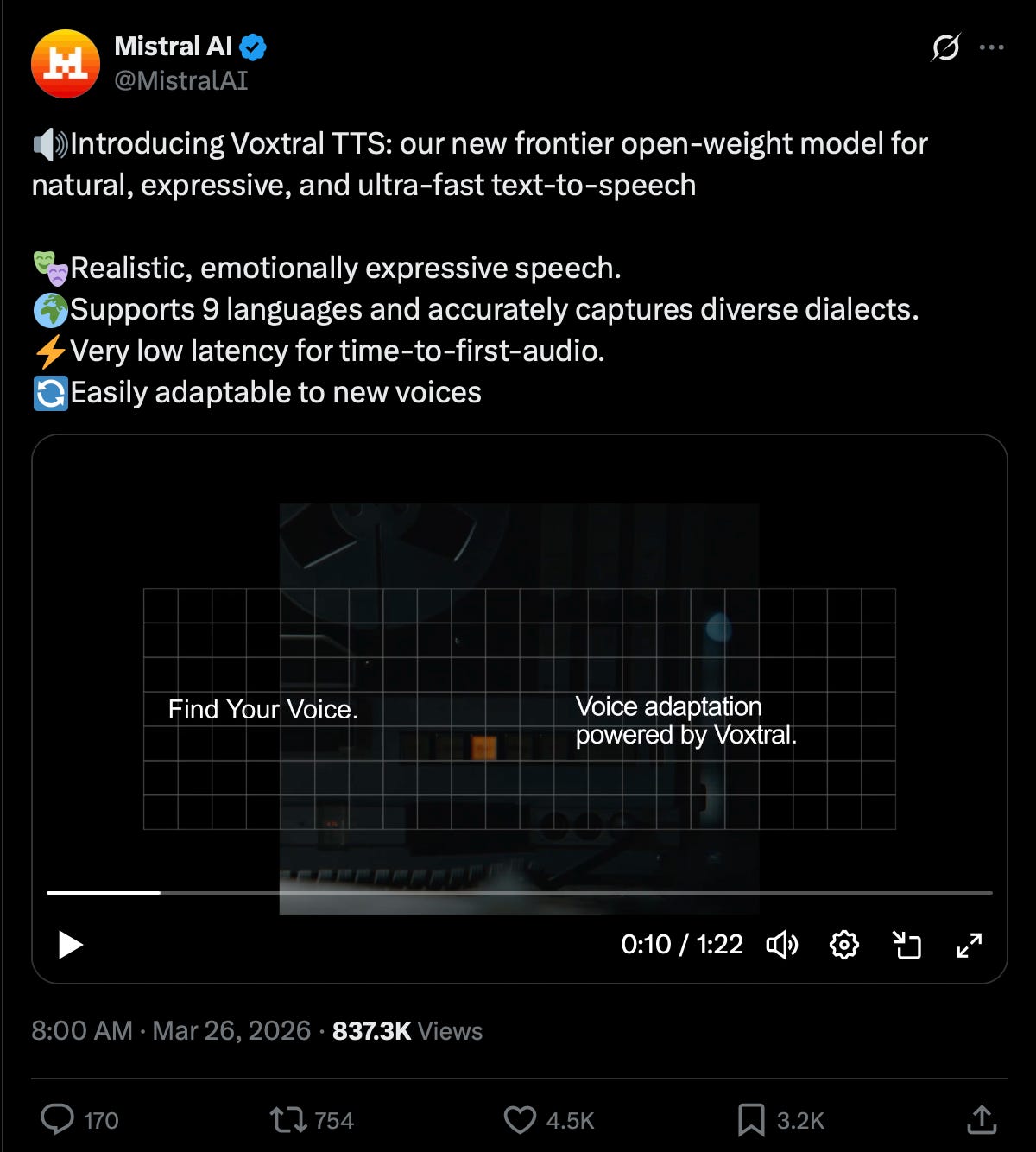
The podcast discusses the release of Voxtral TTS, Mistrals first speech-generation model, which extends their audio research efforts. Built on a 3B parameter architecture based on the Ministral framework, the model excels in efficiency, multilingual support, and speed, making it suitable for real-time applications. Its design integrates semantic and acoustic tokens via a neural audio codec, which splits audio into latent tokens (12.5 Hz sampling rate) and employs a depth transformer to predict tokens autoregressively, handling audios higher entropy more effectively than traditional methods. This approach contrasts with earlier models like Voxtral (ASR-focused) and Walkthrough (audio understanding), emphasizing improvements in flow matching, codec flexibility, and real-time performance.
Key challenges in audio modeling include the need for distinct encoding strategies (e.g., latent tokenization) and balancing quality with resource efficiency, which Voxtral TTS addresses by outperforming competitors in cost-effectiveness. The model also leverages autoregressive flow matching, a novel technique that optimizes real-time generation and reduces latency compared to discrete diffusion methods. Looking forward, Mistral plans to refine its architecture and tokenization methods, explore multimodal integration (combining voice with video and spatial audio), and expand into niche applications like enterprise voice personalization and domain-specific language models. The discussion highlights the broader shift toward specialized audio models over general-purpose systems, with a focus on efficiency, scalability, and custom training solutions for enterprise use cases requiring tailored performance in areas like transcription, synthesis, and natural-sounding voice agents.