7 Aug 2026 Building With Agents Today with Charlie Guo
"Explores AI's shift in software development from IDEs to agent-based tools, transforming workflows, team structures, and future integration challenges."
More Refactoring Podcast episodes
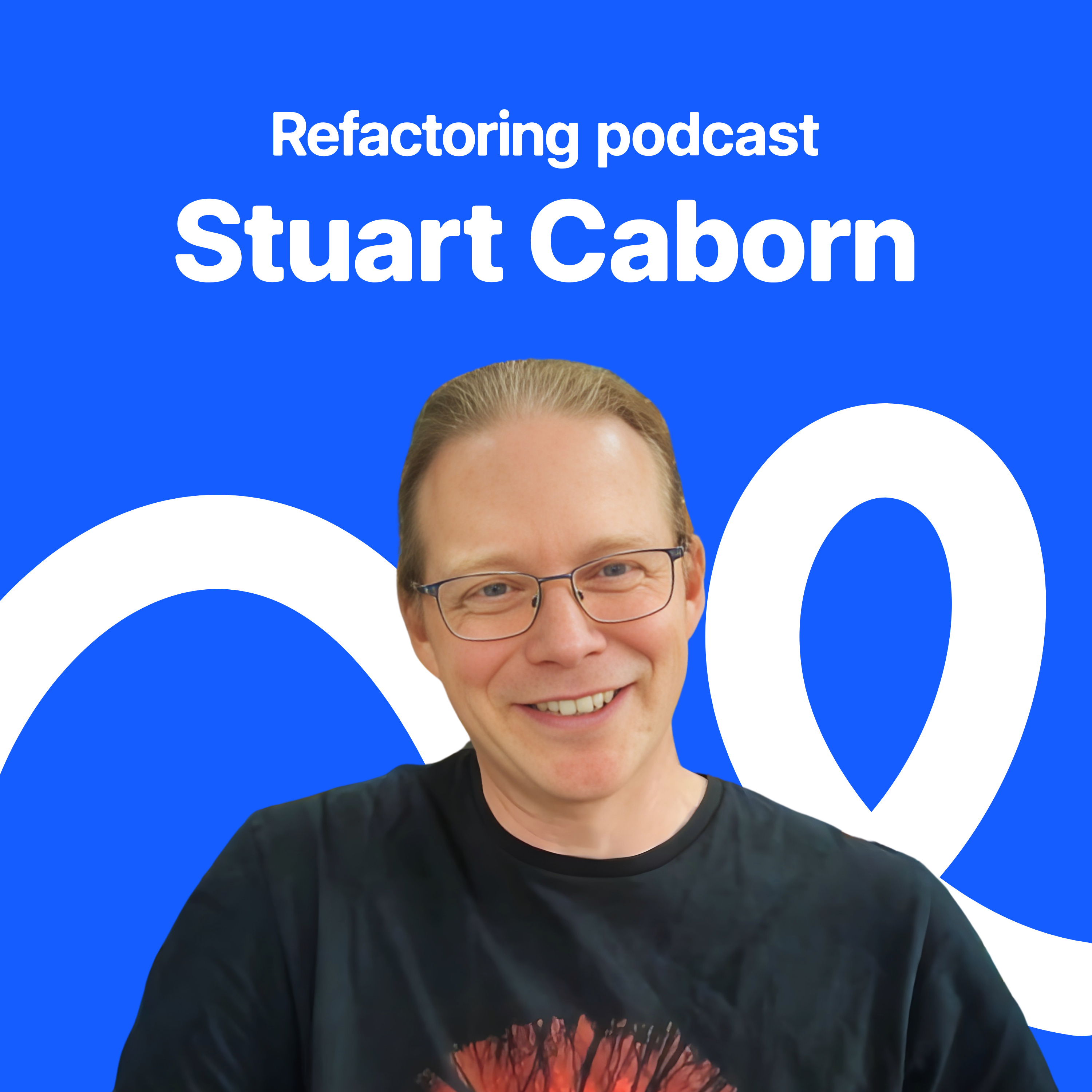
Published 17 Apr 2026
Duration: 01:05:10
AI and large language models are transforming software development by boosting code quality, efficiency, and reliability through human-AI collaboration, as exemplified by Love Holidays' high deployment rates, AI-generated code, and strategies for managing complex systems, data governance, and evolving developer roles.
Today's guest is Stuart Caborn, distinguished engineer at loveholidays, which is an online travel agency with millions of customers around the world.I...
The podcast explores the integration of AI and large language models (LLMs) in enhancing code quality, efficiency, and development workflows. Key themes include the role of LLMs in reducing computational costs and improving code health, as demonstrated by the case of Love Holidays, an online travel agency. This company achieved high deployment frequency (80+ times/month), extensive AI-driven code generation (over 60% of production code), and near-perfect system reliability (under 1% failure rate) by prioritizing code quality through tools like CodeScene and implementing strict guardrails for AI contributions. Challenges in the travel industry, such as managing real-time data, legacy systems, and high-stakes user experiences, highlight the need for human-AI collaboration to balance automation with accountability and reliability. The discussion also emphasizes scalable AI implementation in mission-critical systems, offering insights for other industries.
The podcast further addresses data accessibility via AI, enabling non-technical users to analyze complex datasets and derive actionable insights using tools like BigQuery and dbt. Focus areas include data governance, structured pipelines, and the creation of "data products" to improve visibility and decision-making. Metrics like DORA (Deployment Frequency, Mean Time to Recovery) and qualitative assessments of team sentiment are used to evaluate success. Additional topics include the cultural shift toward embedding AI in workflows, reducing developer resistance through iterative feedback, and the importance of executable documentation and knowledge preservation. The role of guardrails, code health monitoring, and evolving developer roles in an AI-driven landscape are also discussed, alongside the need for continuous improvement through experimentation and shared learning across teams.
7 Aug 2026 Building With Agents Today with Charlie Guo
"Explores AI's shift in software development from IDEs to agent-based tools, transforming workflows, team structures, and future integration challenges."
17 Jul 2026 Speed Is the Only Moat with Anush Elangovan
"AI-driven software development is accelerating through open-source collaboration, balancing innovation with validation, while tech leaders must adapt to AI's role in enhancing productivity and creativity."
10 Jul 2026 The Rise of Malleable Software with Geoffrey Litt
"Malleable software, like Notion, blends structured features with deep customization, evolving through AI and user-driven development to decentralize control, while balancing complexity, automation, and trust."
26 Jun 2026 The Power of Stories with Michael "Rands" Lopp
The evolution of management shifts from technical focus to people-centric leadership, emphasizing storytelling, reflective writing, collaborative idea refinement, and leveraging AI to enhance human roles in mentorship and strategy while balancing empathy, accountability, and evolving skill needs.
12 Jun 2026 Understanding Engineers' Needs with Lara Hogan
Explores human stress responses to AI threats, critiques simplistic narratives, emphasizes nuanced discussions on AI's contextual limitations, and advocates psychological safety, human-centric strategies, and balanced autonomy to integrate AI thoughtfully.