17 Sept 2026 AI Skills with Matt Pocock
"Former voice coach turned developer shares insights on AI integration in software engineering, emphasizing fundamentals, adaptability, and structured workflows for productivity."
More The Pragmatic Engineer episodes
Published 29 Apr 2026
Duration: 01:33:07
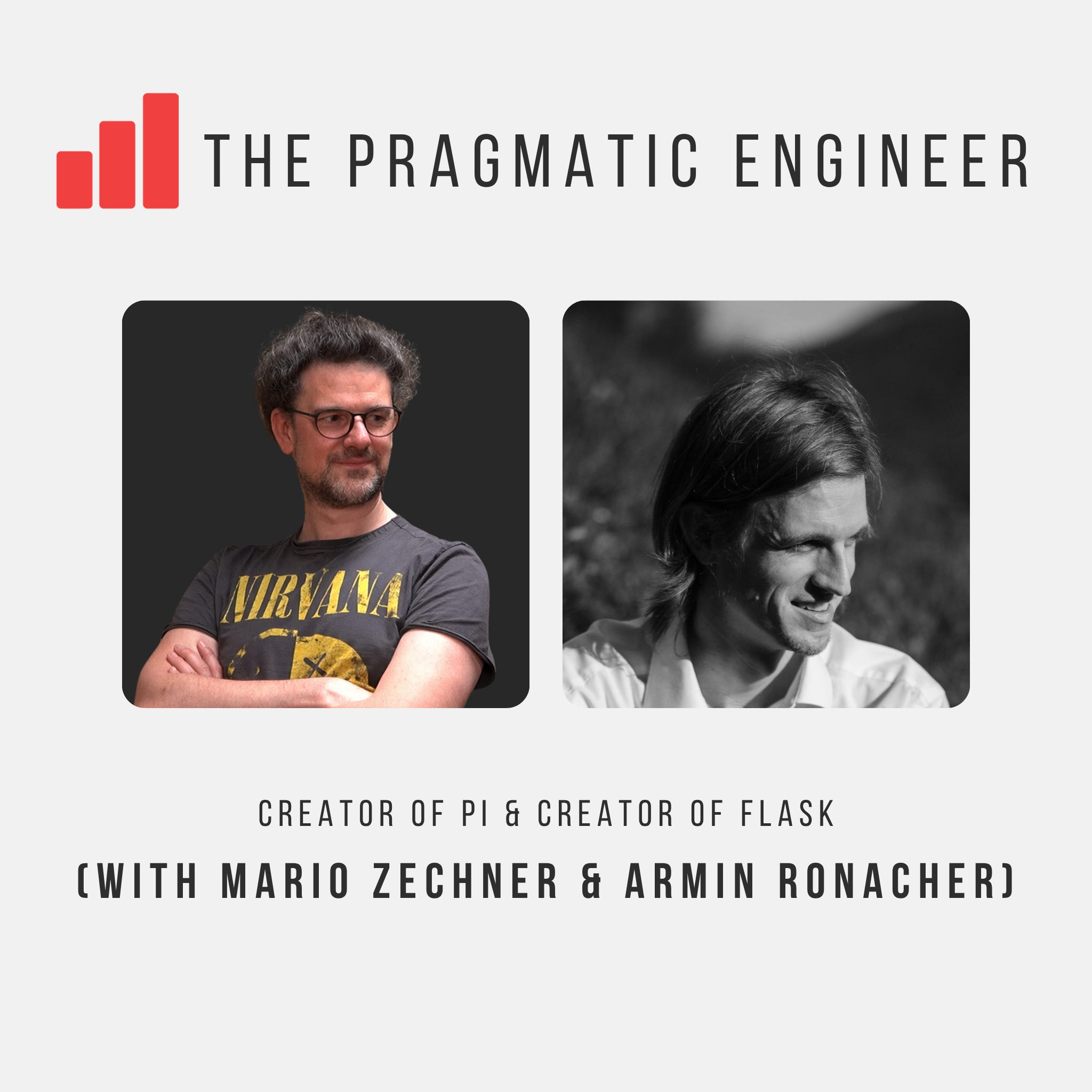
Pi, a minimalist self-modifiable AI coding agent for OpenClaw, examines engineering workflow challenges, ethical concerns, code quality issues, governance of non-expert contributions, and the evolving tension between AI-driven development, open-source ethics, and the enduring role of human expertise in software complexity.
Brought to You By:Statsig The unified platform for flags, analytics, experiments, and more.Sonar The makers of SonarQube, the industry standard for au...
The podcast discusses Pi, a minimalist, self-modifiable AI coding agent developed by Mario Zechner due to frustrations with existing tools. It is used as the backend for OpenClaw, with insights provided by Armin Ronacher, creator of Flask. Key technical topics include the potential of AI to simplify self-modifying software, shifts in engineering workflows driven by AI agents, and critiques of traditional software architectures like MCP (Model-Controller-Provider) in favor of more agile, AI-driven approaches. The rise of CLIs over GUIs is highlighted for their efficiency in integrating with AI tools. Discussions also explore challenges in AI-generated code, including declining quality, the need for human oversight, and the lack of self-awareness in AI agents compared to human developers who learn from mistakes. Senior engineers are emphasized for their ability to foresee complexity and advocate for simplicity, contrasting with AIs tendency to generate either effective or flawed code without consistency.
The conversation delves into broader implications of AI in software development, such as the impact on code quality and review processes, with concerns about "vibe coding" and the psychological burden of managing complex pull requests. Open-source challenges, including licensing conflicts and AI-generated contributions overwhelming projects, are also addressed. A critique of current trends highlights overreliance on AI tools like GitHub Copilot and the risk of dehumanizing engineering through automation. The podcast stresses the importance of balancing speed and quality, advocating for structured friction (e.g., code reviews, approvals) to prevent errors and maintain codebase integrity. While AI shows promise in streamlining repetitive tasks, its limitations in understanding context, learning from errors, and adapting over time are underscored. The discussion concludes with reflections on the need for sustainable, human-centric practices in development, emphasizing that AI should complement rather than replace the nuanced expertise of experienced engineers.
17 Sept 2026 AI Skills with Matt Pocock
"Former voice coach turned developer shares insights on AI integration in software engineering, emphasizing fundamentals, adaptability, and structured workflows for productivity."
9 Sept 2026 Building Codex with Tibo Sottiaux
"Explores Codex's AI-powered coding assistant development, Rust's role, open-source benefits, AI's impact on software workflows, and the future of AI-assisted problem-solving."
26 Aug 2026 Why performant code matters (but gets widely ignored), with Casey Muratori
"Performance optimization in software hinges on early architectural decisions, deep system knowledge, and avoiding premature abstraction, with historical and modern challenges shaping its evolution."
19 Aug 2026 From Chrome DevTools to AI Engineering, with Addy Osmani
"AI is reshaping software engineering by automating coding tasks, while adaptability, leadership, and lifelong learning remain key to thriving in the evolving tech landscape."
12 Aug 2026 Stop being skeptical about AI for development with Charity Majors
"AI's impact on software engineering is reshaping code review, reliability, and career paths, demanding new verification methods, ethical accountability, and adaptability in a rapidly evolving field."