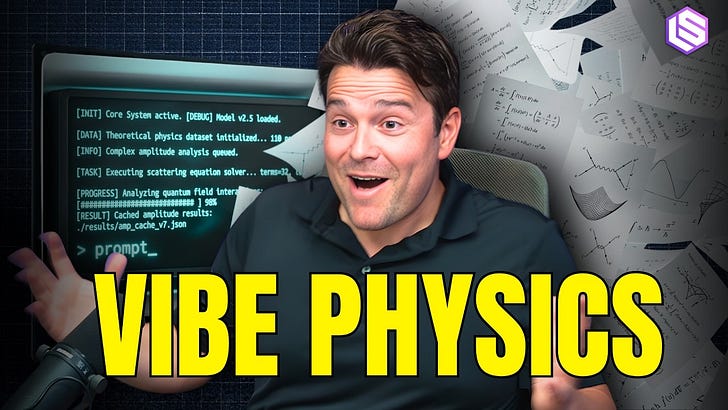
The podcast discusses significant advancements in AI's ability to solve complex theoretical physics problems, such as reproducing research papers in minutes and simulating advanced quantum mechanics models like the SYK model, which had previously been deemed intractable. AI models like GPT-3 and GPT-5 have demonstrated capabilities to handle tasks requiring deep mathematical reasoning, such as deriving formulas for gluon amplitudes in quantum field theory (QFT) and challenging long-standing assumptions about particle interactions. These achievements highlight AI's potential to revolutionize scientific research by accelerating problem-solving, bridging gaps between physics theory and computation, and assisting in tasks like hypothesis testing, code generation, and simulation design. Researchers now widely use AI to tackle complex calculations, including scattering amplitudes and quantum gravity challenges, where traditional methods faced limitations due to factorial complexity and computational infeasibility.
The podcast emphasizes AIs role in reshaping physics research, particularly in addressing problems once requiring months of manual effort, such as resolving non-zero amplitudes in single-minus gluon interactionsa breakthrough that defied earlier symmetry-based exclusions. AI models have also shown promise in identifying patterns in quantum field theory, generalizing simplifications like the Park-Taylor formula to new contexts, and contributing to research on gravitons and quantum gravity. However, challenges remain, including the need for rigorous verification of AI-generated results and the potential for AI to accelerate research at the expense of traditional skill development among students and researchers. The discussion underscores the transformative impact of AI on theoretical physics, its growing integration into academic workflows, and the cultural shift in perceiving AI as a collaborative tool for tackling foundational scientific questions.