17 Sept 2026 AI Skills with Matt Pocock
"Former voice coach turned developer shares insights on AI integration in software engineering, emphasizing fundamentals, adaptability, and structured workflows for productivity."
More The Pragmatic Engineer episodes
Published 13 May 2026
Duration: 01:15:09
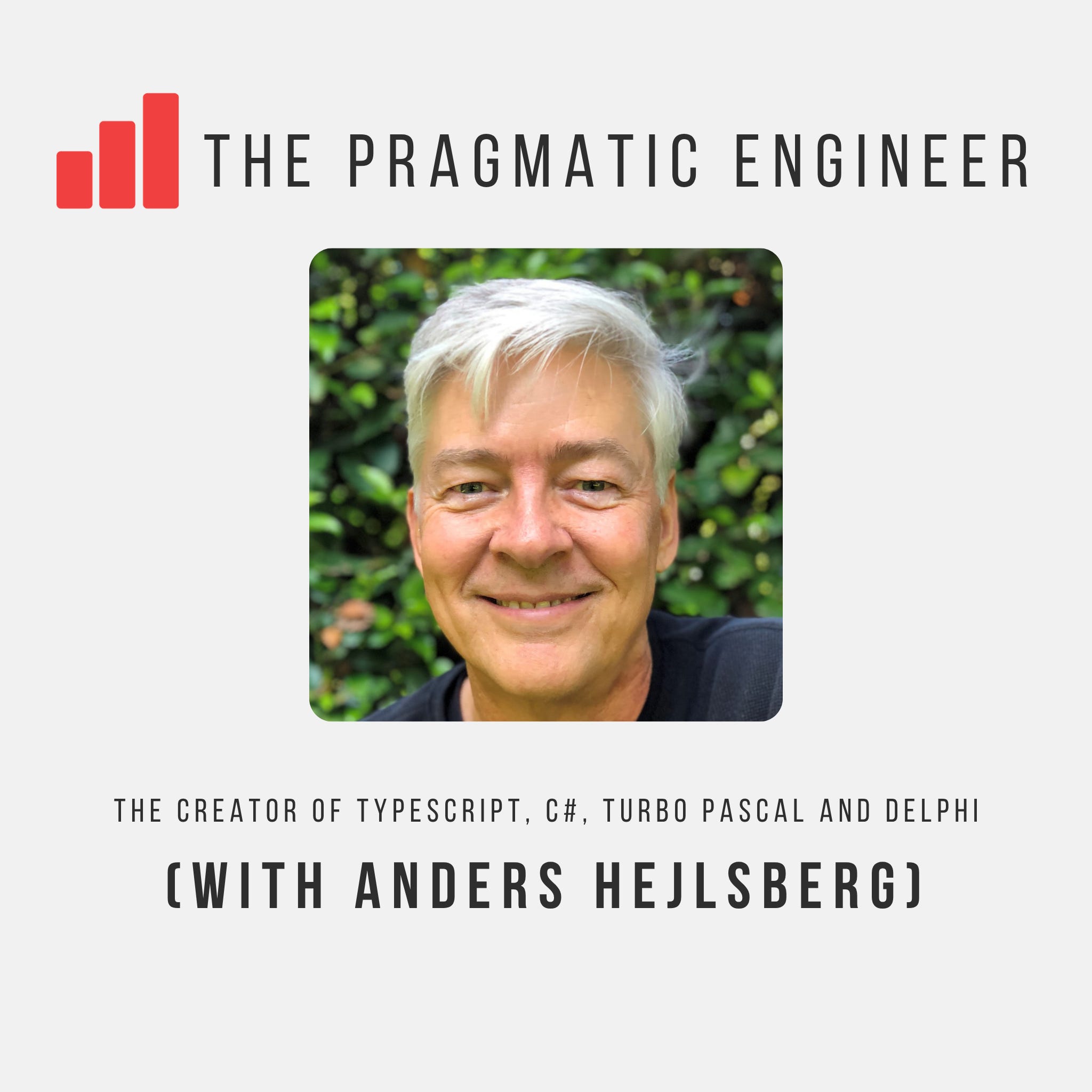
Anders Heilsberg's contributions to programming languages like Turbo Pascal, Delphi, C#, and TypeScriptshaping design philosophies, developer tools, and .NETalongside discussions on AI's impact on coding, type systems, and the evolution of language innovation.
Brought to You By:Antithesis verify your systems correctness without human review or traditional integration tests and avoid bugs or outages.WorkOS Ev...
The podcast explores the contributions and insights of Anders Heilsberg, a pivotal figure in programming language development. He is noted for creating influential languages such as Turbo Pascal, Delphi, C#, and TypeScript, emphasizing his role in shaping developer tools and language design over four decades. Key projects discussed include the impact of the Sun vs. Microsoft Java lawsuit on C#'s creation, the significance of open-sourcing TypeScript and its alignment with Microsoft's internal workflows, and the evolution of language design principles, including the synergy between identifiers and programming constructs. The conversation also delves into the broader implications of AI on programming practices, including challenges in verifying AI-generated code and the need for robust verification methods as software complexity grows. Heilsberg reflects on his early programming experiences, starting with school computers in the 1970s and transitioning from game development to compiler design, highlighting foundational projects like the Pascal compiler predecessor and the development of Turbo Pascal with Borland, which revolutionized development environments with its integrated IDE and affordability.
The discussion further covers the evolution of Delphi, which transitioned from DOS text-based interfaces to Windows GUI applications, rivaling Visual Basic with rapid application development features and the VCL library. Industry trends emphasize the increasing complexity of testing in an AI-driven era, alongside the need for systematic verification of software correctness. The origins of .NET and C# are explored, focusing on their goal to create a language-independent runtime with managed code, garbage collection, and interoperability across languages. Compiler development challenges, such as the Roslin project unifying C#'s compiler and language service, and the design of asynchronous programming features influenced by state machine transformations, are highlighted. Additionally, the conversation touches on TypeScripts role as a superset of JavaScript, its tooling advancements through integration with Visual Studio Code and the Language Server Protocol, and the impact of language design choices on AI integration, including modularity and gradual typing. The dialogue also addresses the symbiotic relationship between AI and programming languages, emphasizing deterministic systems and the balance between developer productivity and tooling efficiency in evolving software development practices.
17 Sept 2026 AI Skills with Matt Pocock
"Former voice coach turned developer shares insights on AI integration in software engineering, emphasizing fundamentals, adaptability, and structured workflows for productivity."
9 Sept 2026 Building Codex with Tibo Sottiaux
"Explores Codex's AI-powered coding assistant development, Rust's role, open-source benefits, AI's impact on software workflows, and the future of AI-assisted problem-solving."
26 Aug 2026 Why performant code matters (but gets widely ignored), with Casey Muratori
"Performance optimization in software hinges on early architectural decisions, deep system knowledge, and avoiding premature abstraction, with historical and modern challenges shaping its evolution."
19 Aug 2026 From Chrome DevTools to AI Engineering, with Addy Osmani
"AI is reshaping software engineering by automating coding tasks, while adaptability, leadership, and lifelong learning remain key to thriving in the evolving tech landscape."
12 Aug 2026 Stop being skeptical about AI for development with Charity Majors
"AI's impact on software engineering is reshaping code review, reliability, and career paths, demanding new verification methods, ethical accountability, and adaptability in a rapidly evolving field."