17 Sept 2026 AI Skills with Matt Pocock
"Former voice coach turned developer shares insights on AI integration in software engineering, emphasizing fundamentals, adaptability, and structured workflows for productivity."
More The Pragmatic Engineer episodes
Published 12 Feb 2026
Duration: 6250
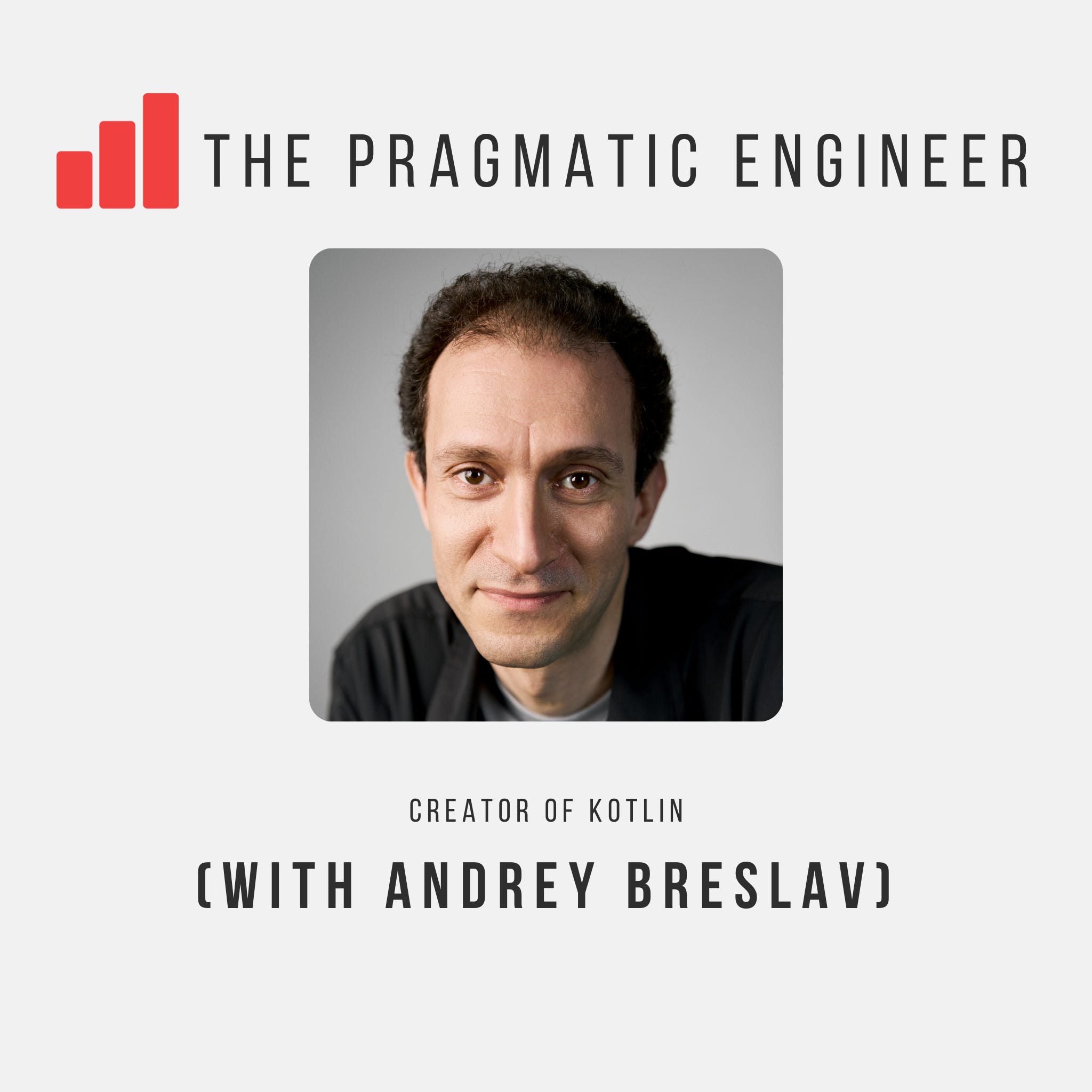
Kotlin, a language designed to improve on Java, has evolved from an IDE plugin to a full-featured programming language with significant traction, particularly after being endorsed by Google.
Brought to You By:Statsig The unified platform for flags, analytics, experiments, and more.Sonar The makers of SonarQube, the industry standard for au...
The podcast covers the development and evolution of Kotlin, focusing on its design roots in languages like Scala, C#, and Groovy. It was created to address Java's limitations by reducing boilerplate code, improving null safety, and enhancing code readability and productivity. Kotlin's interoperability with Java was a key design goal, allowing developers to use existing Java libraries and code seamlessly. The language gained significant popularity after Google officially endorsed it as the preferred language for Android development in 2017, which caught its creators by surprise.
The creation of Kotlin was a long and complex process, initially beginning as an IDE plugin before evolving into a full-featured programming language. The design involved challenges related to syntax and type systems, such as the decision to omit the ternary operator, which is now seen as a regret. The discussion also touches on broader topics like the balance between static and dynamic languages, the complexity of maintaining backward compatibility, and how enterprise needs and AI advancements are shaping programming trends. The conversation ends with a look toward the future, including the creators work on CodeSpeak, a language that leverages natural language and AI to simplify coding by translating human intent into executable code using large language models.
17 Sept 2026 AI Skills with Matt Pocock
"Former voice coach turned developer shares insights on AI integration in software engineering, emphasizing fundamentals, adaptability, and structured workflows for productivity."
9 Sept 2026 Building Codex with Tibo Sottiaux
"Explores Codex's AI-powered coding assistant development, Rust's role, open-source benefits, AI's impact on software workflows, and the future of AI-assisted problem-solving."
26 Aug 2026 Why performant code matters (but gets widely ignored), with Casey Muratori
"Performance optimization in software hinges on early architectural decisions, deep system knowledge, and avoiding premature abstraction, with historical and modern challenges shaping its evolution."
19 Aug 2026 From Chrome DevTools to AI Engineering, with Addy Osmani
"AI is reshaping software engineering by automating coding tasks, while adaptability, leadership, and lifelong learning remain key to thriving in the evolving tech landscape."
12 Aug 2026 Stop being skeptical about AI for development with Charity Majors
"AI's impact on software engineering is reshaping code review, reliability, and career paths, demanding new verification methods, ethical accountability, and adaptability in a rapidly evolving field."